In brief
The essential points
- Akkadian was the principal ancient Assyrian language; cuneiform was its writing system, not the language’s name.
- Aramaic is a different Semitic language that spread before the empire fell and gradually became dominant across the region.
- Modern Assyrian heritage speech includes multiple Neo-Aramaic languages and dialects; Classical Syriac remains a literary and liturgical language.
The short answer across four periods
During the Old, Middle and Neo-Assyrian periods, people used an Assyrian variety of Akkadian, an East Semitic language written mainly in cuneiform. Royal inscriptions, letters, contracts and administrative records preserve it. Babylonian forms of Akkadian and Sumerian remained important in scholarship. “Cuneiform” names the wedge-shaped writing system, which could represent several languages; it was never simply the name of an Assyrian tongue.[1][2]
Aramaic, a related but separate Northwest Semitic language, became increasingly common during the first millennium BCE. In late antiquity, Classical Syriac developed as a major literary form of Aramaic. Modern communities speak or inherit diverse Neo-Aramaic varieties. The sequence is therefore not Akkadian turning into Aramaic, but language contact and gradual shift.[3][4]
Assyrian Akkadian and cuneiform
Akkadian had Assyrian and Babylonian dialect traditions whose forms varied by period, register and scribal education. Old Assyrian merchant letters from Kanesh are unusually personal: spouses discuss textiles and money, partners dispute silver, and travellers report delays. Later royal inscriptions adopt formal language and fixed titles, while archives record orders, rations, loans and lawsuits.[5][2]
Learning cuneiform required command of hundreds of signs with syllabic and logographic values. Scribes studied word lists and older compositions; Sumerian survived as a learned language long after it ceased to be everyday speech. The palace collections at Nineveh demonstrate this multilingual scholarship. Literacy was specialised, not universal, and surviving clay records overrepresent institutions that used durable writing.[6][7]
Aramaic inside the Assyrian Empire
Aramaic-speaking communities lived throughout Syria and Mesopotamia, and Assyrian conquest moved many people within the empire. Alphabetic Aramaic was quicker to write on perishable materials such as parchment or leather than cuneiform on clay. Palace reliefs show two scribes recording booty or personnel, one with a clay tablet and one with a writing board or scroll—strong evidence for parallel administrative practices.[8][3]
Akkadian remained the language of royal monuments and much court correspondence, while Aramaic grew as a lingua franca. This was not an overnight replacement in 612 BCE. Bilingual and multilingual environments existed before the empire’s end, and Akkadian cuneiform continued in Babylonian scholarly settings long afterward. Language boundaries rarely match political borders exactly.[1][3]
Classical Syriac: a literary tradition
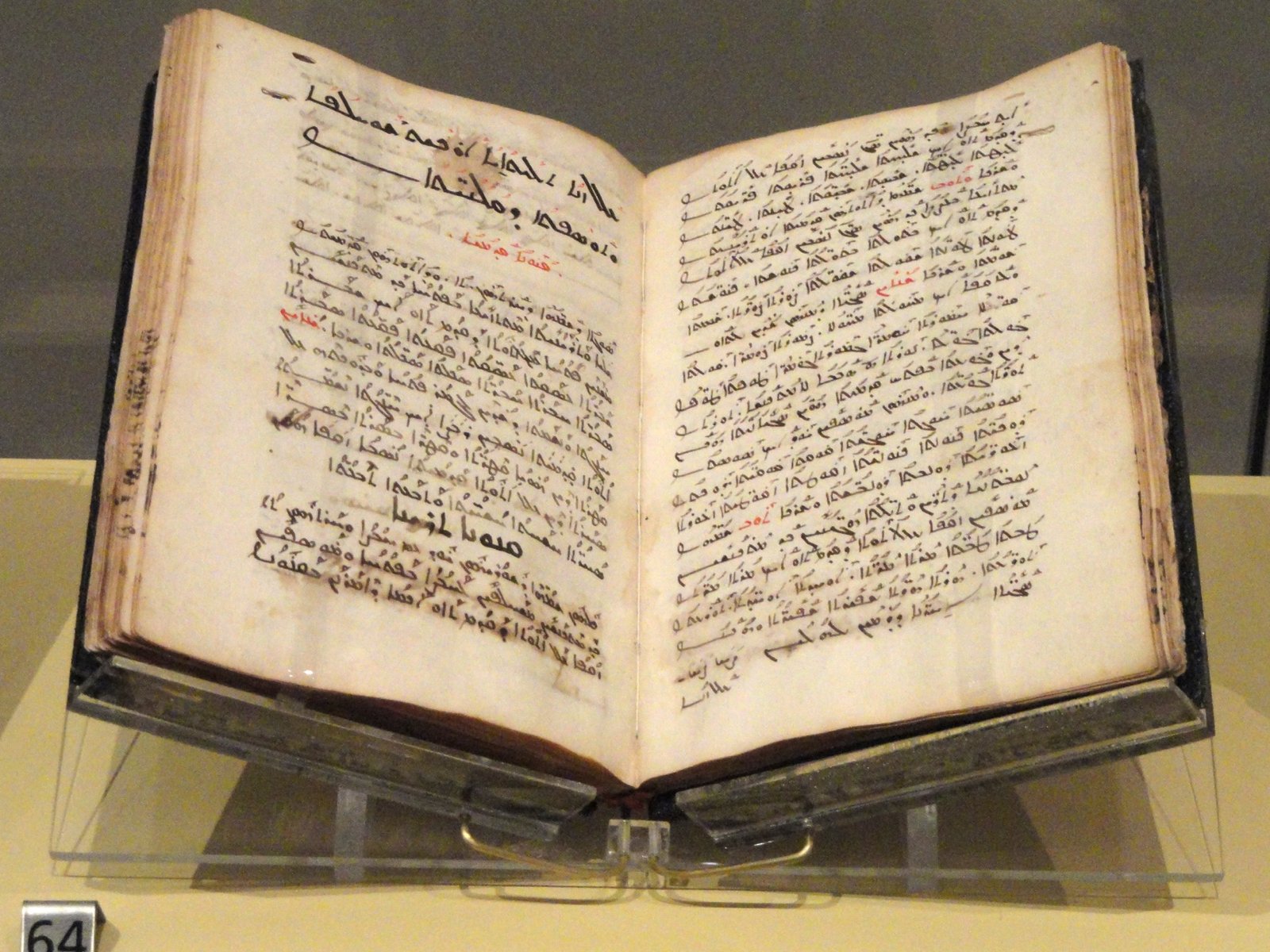
Classical Syriac is an Aramaic literary language associated with Edessa and the growth of Christian writing from the early centuries CE. It supported biblical translation, theology, poetry, historiography, medicine, philosophy and scientific translation. Several church traditions developed distinct scripts, pronunciations and liturgical conventions while sharing a large literary inheritance.[3][9]
Classical Syriac is not identical to every modern vernacular and should not be described simply as “the language Jesus spoke.” Jesus lived in an earlier Aramaic environment with different dialects. Syriac matters to modern Assyrians, Chaldeans, Syriacs, Suryoye and Arameans in varied ways—through worship, schooling, manuscripts and identity—even when it is not the language used at home.[9][10]
Modern Neo-Aramaic varieties
North-Eastern Neo-Aramaic, often shortened to NENA, includes more than one hundred documented varieties historically spoken by Christian and Jewish communities in northern Iraq, south-eastern Türkiye, north-western Iran and nearby regions. Urmi, Barwar and Qaraqosh/Bakhdida traditions are among those studied in detail. Neighbouring Christian and Jewish speech could differ sharply despite centuries of contact.[4][11]
Surayt or Turoyo belongs to Central Neo-Aramaic and is historically associated with Tur Abdin; diaspora communities in Europe now contain many speakers and learners. Community labels such as Sureth, Surayt, Suryoyo, Assyrian and Chaldean overlap with linguistic categories but do not reproduce them exactly. A speaker’s preferred name should be recorded alongside a clear linguistic description.[10][12]
Urmia and modern print
In the nineteenth century, Urmia became a major centre for vernacular Neo-Aramaic printing. Mission presses, local clergy, teachers and writers developed spelling practices and new genres, including periodicals and educational texts. The process changed the relationship between speech, Classical Syriac and print; it should not be portrayed as outsiders creating a language that local communities did not possess.[13][14]
Print also connected dispersed readers and supported modern public identity. Different centres later advanced their own standards, fonts and terminology. No single spelling system represents every dialect, and a literary standard can help communication while also making smaller varieties less visible.[13][15]
Why many varieties are endangered
Sayfo, later massacres, village evacuation, state-language policies, war and economic migration broke dense local networks. In diaspora, children often receive schooling and entertainment in majority languages. A variety once used across neighbours, fields, markets and worship can become limited to conversations with grandparents within two generations.[11][15]
Documentation records grammar, vocabulary and oral history, but archives alone do not keep a language socially alive. Community schools, family use, music, accessible keyboards, teacher training and acceptance of dialect diversity all matter. Revitalisation works best when it does not shame speakers for mixed vocabulary or learners for imperfect fluency.[4][10]
Five misconceptions to avoid
Akkadian did not evolve into Aramaic; the languages are related branches. Cuneiform was a script, not a language. Modern Neo-Aramaic does not descend directly from Classical Syriac in a simple straight line, even though the literary language influenced vocabulary and writing. Not all Neo-Aramaic is “Assyrian,” since historically Jewish and other communities also speak varieties. And no single modern dialect is the unchanged speech of Nineveh’s kings.[3][4]
The positive conclusion is more interesting: Assyrian history is deeply multilingual. Akkadian, Sumerian scholarship, Aramaic, Classical Syriac and modern vernaculars each belong to different social worlds. Following their contact and change reveals how communities adapt, rather than turning language into a purity test.[1][9]
Evidence trail
Sources and further reading
- Eckart Frahm, ed.. A Companion to Assyria. Wiley-Blackwell, 2017.
Specialist chapters covering Assyrian history, language, cities, institutions and later reception.
- A. Kirk Grayson and project editors. Royal Inscriptions of Assyria online. Open Richly Annotated Cuneiform Corpus, University of Pennsylvania.
Scholarly editions and translations for Assyrian royal inscriptions through 745 BCE.
- Holger Gzella. A Cultural History of Aramaic: From the Beginnings to the Advent of Islam. Brill, 2015.
- Geoffrey Khan and project team. North-Eastern Neo-Aramaic Database Project. University of Cambridge.
Documented audio and linguistic data for North-Eastern Neo-Aramaic varieties.
- UNESCO Memory of the World. The Old Assyrian Merchant Archives of Kültepe. UNESCO.
Overview of the merchant archive from ancient Kanesh.
- Jon Taylor and project team. What was Ashurbanipal’s Library?. British Museum research project, 2020–2024.
Research on the size, origins, colophons and archaeological contexts of the Nineveh tablet collections.
- British Museum and LMU Munich. Reading the Library of Ashurbanipal. Open Richly Annotated Cuneiform Corpus, 2022–.
Project documentation and editions for the Nineveh scholarly collections.
- Silvie Zamazalová. Aramaic and Hebrew in Alphabetic Scripts. The Nimrud Project, ORACC.
- Aaron Michael Butts. Assyrian Christians. A Companion to Assyria, Wiley-Blackwell, 2017.
- Šlomo Surayt project. Surayt Aramaic Online Course. Erasmus+ language project.
- Geoffrey Khan. Endangered dialects of Aramaic. University of Cambridge, 2008.
- UNESCO World Heritage Centre. Late Antique and Medieval Churches and Monasteries of Midyat and Surrounding Area (Tur Abdin). Tentative List.
A state-party nomination with UNESCO’s standard disclaimer; useful for site descriptions, not an adjudication of identity.
- Heleen Murre-van den Berg. From a Spoken to a Written Language: The Introduction and Development of Literary Urmia Aramaic in the Nineteenth Century. Nederlands Instituut voor het Nabije Oosten, 1999.
- Adam H. Becker. Revival and Awakening: American Evangelical Missionaries in Iran and the Origins of Assyrian Nationalism. University of Chicago Press, 2015.
Emphasises missions, education, print and modern national formation in Iran.
- Naures Atto. Hostages in the Homeland, Orphans in the Diaspora: Identity Discourses among the Assyrian/Syriac Elites in the European Diaspora. Leiden University Press, 2011.