In brief
The essential points
- “Ashurbanipal’s Library” is a modern umbrella term for overlapping royal, temple and scholarly collections from several Nineveh contexts.
- The holdings included divination, medicine, ritual, lexical scholarship, literature, correspondence and administration.
- More than 30,000 tablets and fragments do not equal 30,000 complete works, and Ashurbanipal did not write the Epic of Gilgamesh.
A king trained in scholarship
Ashurbanipal ruled Assyria from 668 to about 631 BCE, according to the chronology used by the Royal Inscriptions project. Royal texts present him as unusually skilled in scribal learning: able to read complex signs, engage with omens and master scholarly disciplines. A stylus appears tucked into his belt in a palace relief. Such statements are self-presentation, but letters, colophons and the scale of collecting support a genuine court investment in learning.[1][2]
That does not mean the king personally read or copied every tablet. Scholarship at court depended on generations of trained scribes, diviners, physicians, lamentation priests and learned families. They advised the ruler, interpreted unusual events, performed rituals and maintained textual traditions. The library story is therefore about an institution and its workers as much as one famous patron.[3][4]
What “the library” actually means
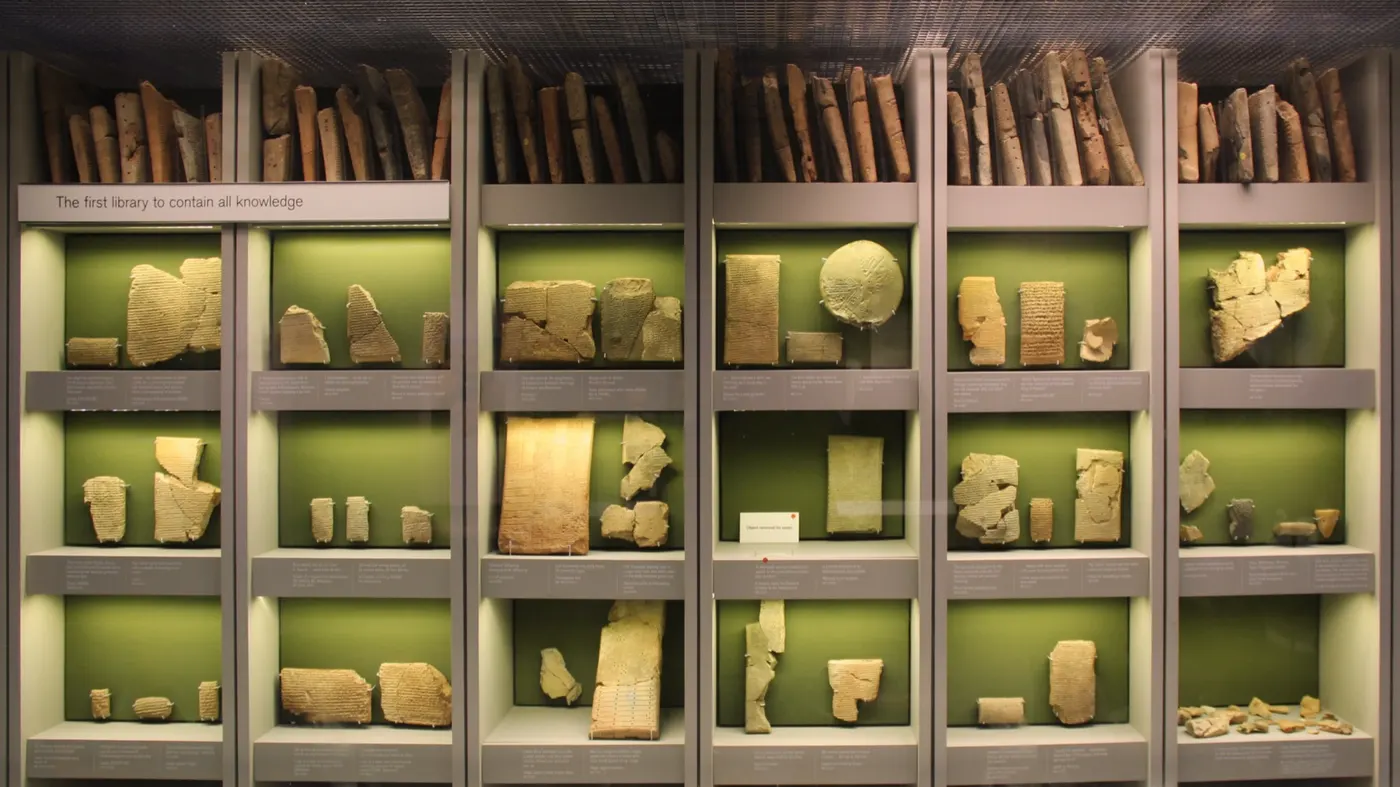
More than 30,000 clay tablets and fragments excavated at Nineveh are conventionally associated with Ashurbanipal’s Library. A fragment may be part of a tablet that has broken into many pieces, so the number is not a count of distinct books. The finds also came from different parts of Kuyunjik, including the Southwest and North Palaces and temple-connected settings. Some collections predated Ashurbanipal; others belonged to institutions or scholars around him.[3][4]
Modern libraries encourage an image of one building with labelled shelves. Nineveh offers something more complicated: rooms, deposits and collections that changed over time, were disturbed in antiquity and were imperfectly recorded by early excavators. Researchers use clay composition, handwriting, text joins, colophons and excavation notes to reconstruct relationships. “Library” remains useful if it opens that complexity instead of concealing it.[3][5]
How texts reached Nineveh
Court scholars copied and collated tablets from Assyrian and Babylonian centres. Letters show officials acquiring material; colophons record ownership, copying, checking and intended use. Some exemplars were requested, some texts were recopied locally, and some material may have arrived through political pressure or war. The process joined royal resources to a much older Mesopotamian scribal culture.[4][3]
Babylonia held exceptional scholarly prestige. Assyrian kings could fight Babylonian rulers while valuing Babylonian temples, learned lineages and compositions. Ashurbanipal’s collection therefore should not be described as a purely national archive. It preserved and reorganised traditions from across Mesopotamia for a specific seventh-century court and its religious, medical, political and intellectual needs.[5][1]
What the tablets contained
A large share of the material is technical scholarship: omen series used to interpret celestial, terrestrial and bodily signs; diagnostic and therapeutic medicine; rituals, prayers and incantations; lexical lists that organised words and signs; and commentaries that explained difficult traditions. Such texts reveal a world in which knowledge, religion and statecraft were not separate modern departments.[3][4]
The collections also contain royal correspondence, administrative records and literary works. Copies of the Epic of Gilgamesh became the most famous, especially after George Smith identified a Mesopotamian flood narrative in the nineteenth century. Yet Ashurbanipal did not compose Gilgamesh. The standard Babylonian poem was already ancient, and the Nineveh witnesses preserve one stage within a long history of transmission.[3][5]
Copies can preserve much older knowledge
A seventh-century tablet may transmit a composition with roots centuries earlier. Scribes did not simply photocopy stable originals: they selected, compared, corrected and sometimes reorganised material. Different copies preserve variants, gaps and learned decisions. This is why fragments that look repetitive can be historically valuable. They show how knowledge was used, not only what a hypothetical first version said.[4][3]
Cuneiform itself was a writing system used for several languages. Scholarly tablets at Nineveh might contain Akkadian in Assyrian or Babylonian forms, Sumerian passages or bilingual organisation. Aramaic was increasingly important in imperial life, but clay cuneiform remained central to the learned traditions assembled for the king.[5][6]
How destruction helped and hindered survival
When Nineveh fell in 612 BCE, buildings collapsed and collections were disturbed. Heat may have hardened some clay, but the popular claim that one great fire neatly baked and preserved the whole library is too simple. Tablets had different production histories; many were already durable, while others shattered, eroded or remained buried. The same destruction that preserved contexts also mixed and displaced them.[3][7]
Recent research concludes that excavators did not find a single collection frozen where it stood. Tablets had been sifted, smashed and dumped in ancient and modern episodes. Much material may remain in the ruins. Preservation is therefore partial and accidental, not the fulfilment of a king’s plan to send an intact archive to the future.[3][4]
Excavation, decipherment and missing context
Excavations at Kuyunjik in the mid-nineteenth century recovered enormous numbers of fragments. Hormuzd Rassam’s 1853 work in Ashurbanipal’s North Palace was especially important. Early competition rewarded spectacular objects and rapid transport to museums, while recording standards were limited. As a result, the exact room or layer for many tablets is uncertain.[3][2]
In 1872, British Museum assistant George Smith announced that he had recognised a flood story related to the biblical account. The public response helped make cuneiform literature famous, but decipherment was a collective and international achievement. Today digital catalogues, photographs and text editions allow fragments dispersed through museum systems to be compared and joined, while questions of excavation history and ownership remain part of the archive’s meaning.[3][4]
Why the collections still matter
The Nineveh tablets preserve an unmatched cross-section of Mesopotamian learning. They illuminate how scholars classified illness, read the sky, advised kings, taught signs, interpreted old texts and transmitted stories. They also show the limits of survival: what happened to be collected for court is not a neutral sample of everything known across Mesopotamia.[3][5]
Calling it “the world’s first library” turns a complex history into a race for precedence; older archives and collections are known elsewhere. Its significance does not need that claim. Ashurbanipal’s resources created a remarkable concentration of textual traditions, and the fragmentary remains continue to produce new readings more than a century and a half after their excavation.[4][3]
Evidence trail
Sources and further reading
- Grant Frame, director. Royal Inscriptions of the Neo-Assyrian Period. Open Richly Annotated Cuneiform Corpus, University of Pennsylvania.
Searchable scholarly editions and translations of royal inscriptions; these texts are royal political compositions, not neutral chronicles.
- British Museum. Who was Ashurbanipal?. British Museum blog, 2018.
- Jon Taylor and project team. What was Ashurbanipal’s Library?. British Museum research project, 2020–2024.
Research on the size, origins, colophons and archaeological contexts of the Nineveh tablet collections.
- British Museum and LMU Munich. Reading the Library of Ashurbanipal. Open Richly Annotated Cuneiform Corpus, 2022–.
Project documentation and editions for the Nineveh scholarly collections.
- Eckart Frahm, ed.. A Companion to Assyria. Wiley-Blackwell, 2017.
Specialist chapters covering Assyrian history, language, cities, institutions and later reception.
- Silvie Zamazalová. Aramaic and Hebrew in Alphabetic Scripts. The Nimrud Project, ORACC.
- British Museum. Fall of Nineveh Chronicle, BM 21901. British Museum collection.
Babylonian chronicle covering the decisive campaigns of 616–609 BCE.