In brief
The essential points
- Assyria began as a city-centred polity at Ashur, not as a ready-made empire.
- Old, Middle and Neo-Assyrian are useful modern period labels; their boundaries and absolute dates can vary.
- Nineveh fell in 612 BCE and the last organised royal resistance ended in 609 BCE, but people and settlement in Assyria continued.
How historians date Assyrian history
Assyrian chronology is unusually rich, but it is not perfectly fixed. Officials called limmu or eponyms gave their names to individual years, king lists preserve sequences of rulers, and a recorded solar eclipse anchors much of the first-millennium chronology. Synchronisms with Babylonian, Egyptian, Hittite and Levantine sources help connect local calendars. Even so, missing entries, different rules for accession years and competing reconstructions create one-year variations for several late kings and larger alternatives in the second millennium BCE.[2][4]
The familiar labels Old Assyrian, Middle Assyrian and Neo-Assyrian are scholarly tools. Ancient writers did not consistently divide their past in that way. This timeline uses approximate dates where the evidence does not justify false precision, gives both 612 and 609 BCE their distinct meanings, and treats royal inscriptions as commissioned statements of power. Those inscriptions are essential evidence, but they need to be read alongside letters, accounts, chronicles, objects and archaeology.[1][3]
Before empire: the city of Ashur
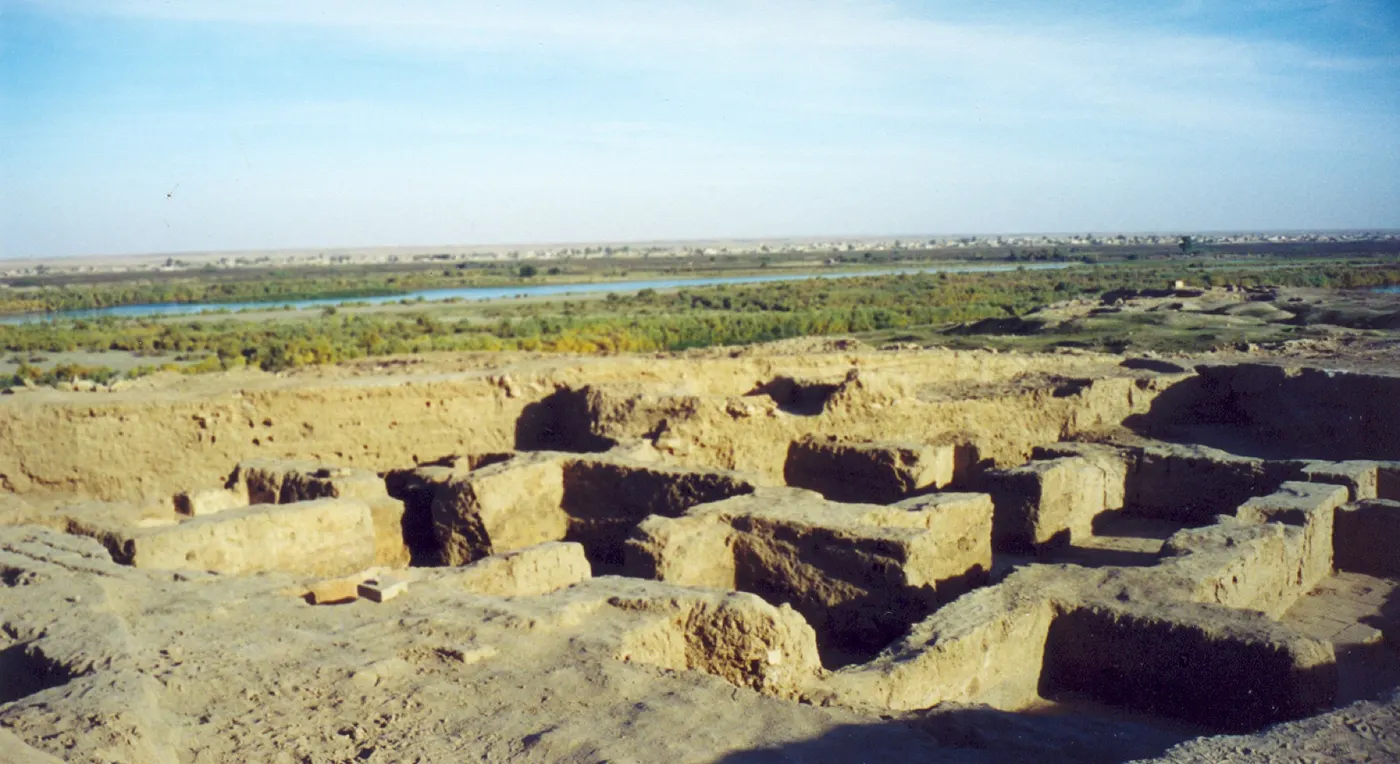
By the third millennium BCE a settlement had developed on a rocky terrace above the Tigris. The location sat between irrigated southern Mesopotamia, rain-fed northern plains and routes leading toward Anatolia and the Iranian highlands. Ashur became at once the city’s name, the name of its principal god and, eventually, the name of a wider country. Those meanings grew together over centuries; the earliest town should not be imagined as the capital of a fully formed ethnic nation or imperial programme.[6][1]
In the early second millennium BCE, Ashur was a compact city-state with energetic institutions and merchant families. Thousands of letters and legal documents from Kanesh, at modern Kültepe in Türkiye, show traders moving tin and textiles, extending credit, negotiating partnerships and writing home about marriages, inheritances and disputes. The merchants kept legal and familial ties to Ashur, but their trading quarters in Anatolian cities were not conquered Assyrian colonies in the later imperial sense.[5][7]
Regional kingdoms and the rise of a great power
In the early eighteenth century BCE, Shamshi-Adad I incorporated Ashur into a larger Upper Mesopotamian kingdom ruled through a network of palaces and family appointments. That state did not long survive him, and it is misleading to turn it into a simple “first Assyrian Empire.” During the following centuries Assyria operated in a political world shaped by Mitanni, Babylonia and the Hittites. The degree and duration of Mitannian control remain debated because the record is uneven.[1][2]
Around the mid-fourteenth century BCE, Ashur-uballit I used Mitanni’s decline to enter great-power diplomacy. In letters to the Egyptian court he addressed the pharaoh as a brother and protested when his envoys were treated as less important than those of other kings. His intervention in a Babylonian succession dispute demonstrates growing reach, though the full sequence is reconstructed partly from later chronicles. Scholars date his reign differently according to their preferred second-millennium chronology.[3][15]
The Middle Assyrian territorial state
Thirteenth-century kings including Adad-nirari I, Shalmaneser I and Tukulti-Ninurta I built a durable territorial system. Provinces, governors, storehouses and military obligations extended Assyrian administration west into the Khabur basin and beyond. Law collections and archives reveal household economies, hierarchical social categories and severe state power. Conquest also brought forced movement of populations—an established technique of ancient states that Assyria later deployed on a much larger scale.[2][1]
Tukulti-Ninurta I captured Babylon and carried away its king, but Assyrian control there was temporary. Tiglath-Pileser I, ruling from 1114 to 1076 BCE, campaigned across the northern mountains and into Syria, reached the Mediterranean and celebrated hunting as a sign of mastery. His texts make an impressive geographical catalogue; they do not prove that every place named became a lasting province. After his reign Assyria lost territory and reach, but the core state and its institutions endured.[3][2]
Recovery and the ninth-century empire
Reconquest gathered pace under Ashur-dan II and Adad-nirari II. Some historians begin the Neo-Assyrian period with Ashur-dan in 934 BCE; others use Adad-nirari’s accession in 911 because sustained expansion is clearer from that point. Their successors reclaimed routes, farming districts and towns that earlier Assyrian kings had ruled. Annual campaigning linked military success to taxes, labour and the movement of goods into the royal centre.[1][2]
Ashurnasirpal II made Kalhu the principal court city and filled its Northwest Palace with carved stone reliefs. In 879 BCE, a royal inscription describes a great inauguration banquet whose enormous figures are better understood as courtly self-presentation than a modern audited count. Shalmaneser III repeatedly campaigned west. At Qarqar in 853 he claimed victory over a coalition, yet that coalition’s members remained active and further campaigns were needed. The record reveals resistance as well as expansion.[3][8]
Tiglath-Pileser III and the high empire
A revolt in 746 BCE was followed by Tiglath-Pileser III’s accession in 745. His ancestry is uncertain, but the transformation under his rule is clear. More conquered territories were annexed as provinces, governorships were often reduced in size, military forces became more centrally controlled, and communications joined court, army and local officials. Mass resettlement was coercive and disruptive; it also moved skilled labour and farming communities into new parts of an increasingly diverse empire.[4][1]
Sargon II founded the planned city Dur-Sharrukin, defeated Urartu in 714 and died on campaign in 705. Sennacherib abandoned his father’s new court city and transformed Nineveh with walls, canals, gardens and the Southwest Palace. Esarhaddon rebuilt Babylon after Sennacherib’s destruction and captured Memphis in Egypt in 671. Ashurbanipal inherited a vast state, fought his brother in Babylon, campaigned in Elam and sponsored the scholarly collections recovered at Nineveh.[4][9]
626–609 BCE: war, defeat and what followed
The final crisis came after an internal war and an obscure succession. Nabopolassar established himself in Babylon in 626 BCE. Babylonian and Median forces then carried war into the Assyrian core: the Medes took Ashur in 614, the coalition captured Nineveh in 612, and Harran fell in 610. An Egyptian-supported Assyrian remnant led by Ashur-uballit II attempted to retake Harran in 609 but failed. The Babylonian chronicle is the principal chronological spine for these campaigns.[10][11]
What ended was the royal dynasty, central administration and imperial army. Archaeology and later written evidence do not support the idea that every inhabitant died or that northern Mesopotamia became empty. Settlement continued in altered forms, Assyrian personal names appear in later records, and Ashur experienced later revivals. The difficult question is not whether anyone survived, but how political, regional, linguistic and cultural continuities changed after the state disappeared.[12][13][14]
Evidence trail
Sources and further reading
- Karen Radner. Ancient Assyria: A Very Short Introduction. Oxford University Press, 2015.
A concise scholarly synthesis of Assyrian geography, society and imperial history.
- Eckart Frahm, ed.. A Companion to Assyria. Wiley-Blackwell, 2017.
Specialist chapters covering Assyrian history, language, cities, institutions and later reception.
- A. Kirk Grayson and project editors. Royal Inscriptions of Assyria online. Open Richly Annotated Cuneiform Corpus, University of Pennsylvania.
Scholarly editions and translations for Assyrian royal inscriptions through 745 BCE.
- Grant Frame, director. Royal Inscriptions of the Neo-Assyrian Period. Open Richly Annotated Cuneiform Corpus, University of Pennsylvania.
Searchable scholarly editions and translations of royal inscriptions; these texts are royal political compositions, not neutral chronicles.
- UNESCO Memory of the World. The Old Assyrian Merchant Archives of Kültepe. UNESCO.
Overview of the merchant archive from ancient Kanesh.
- UNESCO World Heritage Centre. Ashur (Qal’at Sherqat). World Heritage List, 2003–.
Site history, significance and conservation status.
- Metropolitan Museum of Art. The Old Assyrian Period (ca. 2000–1600 B.C.). Heilbrunn Timeline of Art History.
- Joan Aruz, Sarah B. Graff and Yelena Rakic, eds.. Assyria to Iberia at the Dawn of the Classical Age. The Metropolitan Museum of Art, 2014.
Museum scholarship on Assyrian art, imperial imagery and interregional exchange.
- Jon Taylor and project team. What was Ashurbanipal’s Library?. British Museum research project, 2020–2024.
Research on the size, origins, colophons and archaeological contexts of the Nineveh tablet collections.
- British Museum. Fall of Nineveh Chronicle, BM 21901. British Museum collection.
Babylonian chronicle covering the decisive campaigns of 616–609 BCE.
- Simonetta Ponchia. The End of the Neo-Assyrian Empire. The End of Empires, Springer Nature, 2022.
Reviews sparse late evidence and competing explanations for imperial collapse.
- Stefan R. Hauser. Post-Imperial Assyria. A Companion to Assyria, Wiley-Blackwell, 2017.
- Karen Radner. Assur’s “Second Temple Period”: The Restoration of the Cult of Aššur, c. 538 BC. Herrschaftslegitimation in vorderorientalischen Reichen der Eisenzeit, Mohr Siebeck, 2017.
Open-access study of cult and settlement after the fall of the empire.
- Heather D. Baker. Assyrian Names. Personal Names in Cuneiform Texts from Babylonia (c. 750–100 BCE), Cambridge University Press, 2024.
Evidence for Assyrian names in post-imperial cuneiform records.
- Jonathan Valk. Ancient Assyrians: Identity and Society in Antiquity and Beyond. Cambridge University Press, 2025.
A study of Assyrian social categories that cautions against projecting modern identity models unchanged into antiquity.