In brief
The essential points
- Assyrian performance includes liturgical chant, village repertoires, line dance, popular music and concert work rather than one uniform tradition.
- Shared regional forms can carry distinct Assyrian meanings without becoming the exclusive property of one people.
- Recording, migration and the internet transform performance; cultural change is not evidence that a tradition is inauthentic.
Why performance matters in a dispersed community
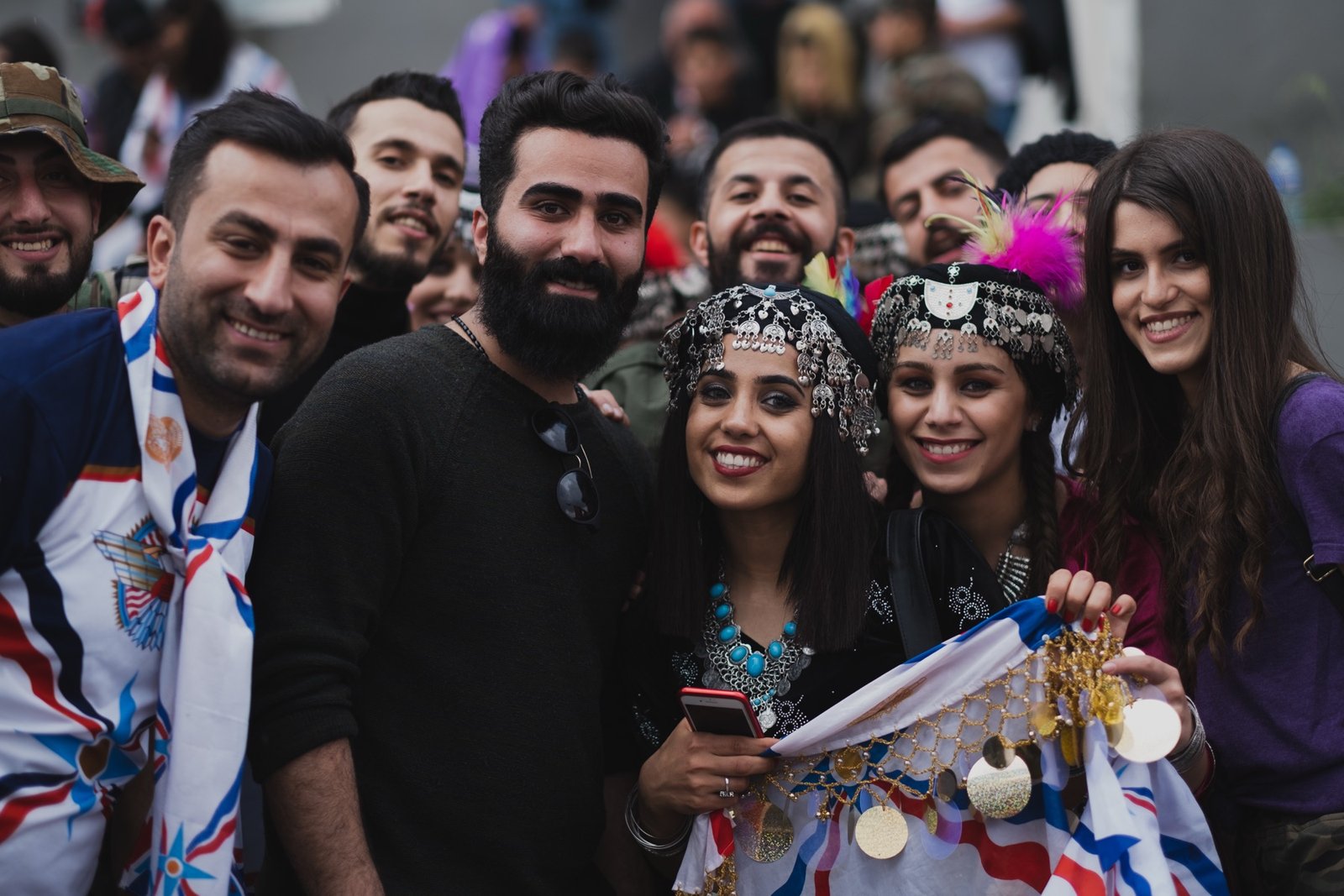
Music and dance create belonging through bodies, voices and repetition. At a wedding or Akitu gathering, people who speak different dialects or majority languages can still join a line, recognise a melody or respond to a refrain. Performance turns identity from an abstract label into a social relationship made in the moment.[1][4]
There is no single Assyrian sound. Liturgical chant, regional village songs, laments, wedding bands, electronic pop and composed concert music follow different rules and histories. A complete account names those differences rather than presenting one rhythm, costume or instrument as the unchanging survival of ancient Assyria.[3][1]
Weddings, festivals and the social life of line dance
Line dances organise participants through linked hands, repeated steps and a leader who may carry a handkerchief. Variants differ by region, tempo and event. Learning often happens by joining rather than through formal instruction, so a dance line can welcome beginners while also displaying skill and generational memory.[1]
Sheikhani provides a well-documented transnational example. Performers use song and movement to embody a nation without a state across homeland and diaspora settings. That case should not be made universal: fieldwork in one community records a situated practice, not every Assyrian wedding in Iraq, Sweden, Australia or North America.[1][2]
Voice, lyrics and collective memory
Songs carry Neo-Aramaic language into settings where daily fluency may be declining. A chorus can preserve phrases, pronunciation and emotional association even when listeners need translation. Lyrics narrate village life, migration, love, Sayfo, political hopes and homes imagined from a distance.[2][4]
Memory changes when it is performed. A lament can become a concert piece; a political song can be remixed for a wedding or online audience. This does not make memory false. It shows how communities transmit the past through forms that remain meaningful to new listeners.[3][2]
Chant, lament, protest and popular music
Church chant belongs to liturgical systems with their own texts, modes and calendars. It should not be collapsed into commercial “folk music,” although singers and audiences may move between sacred and popular worlds. Laments and memorial songs likewise have distinct social purposes that can change when recorded or staged.[5][3]
Twentieth-century and contemporary performers adopted instruments, recording techniques and genres encountered in Iraq, Iran, Türkiye, the Soviet world and the West. These exchanges produced recognisably Assyrian popular music without requiring cultural isolation. Innovation is a normal historical process, not proof of borrowed identity.[3][1]
Recording, radio and digital audiences
Records, cassettes, radio and video allowed performers to reach listeners across migration routes. The internet accelerated that process: a song produced in Sweden can circulate in Iraq, Australia and the United States within hours. Online platforms also make spelling, subtitles and visual symbols part of musical presentation.[2]
Digital circulation helps preservation while creating new vulnerabilities. Platform algorithms reward certain styles; files lose context; artists may not control copies; smaller dialect traditions remain hard to discover. Archives need performer consent, useful metadata and long-term stewardship, not simply large folders of detached media.[2][3]
Preserving performance without freezing it
Teaching dance, documenting elders, supporting choirs and commissioning new work can all sustain heritage. Preservation succeeds when it leaves room for regional difference, mixed ability and new creation. Demanding one “pure” style may exclude the very young people whose participation keeps a practice alive.[3][4]
The strongest cultural record combines audiovisual documentation with the stories of performers and audiences: who taught the piece, where it was used, what the words mean and how it changed. That context turns a clip into history and allows future listeners to hear both continuity and invention.[3][1]
Evidence trail
Sources and further reading
- Nadia Younan. Stateless Rhythms, Transnational Steps: Embodying the Assyrian Nation through Sheikhani Song and Dance. Revue européenne des migrations internationales, 2019.
- Dan Lundberg. Welcome to Assyria—Your Land on the Cyber Space. Etnomusikologia.
- Lolita Emmanuel. From the Fragments, We Make “Something Anew”. Music & Practice, 2024.
- Naures Atto. Hostages in the Homeland, Orphans in the Diaspora: Identity Discourses among the Assyrian/Syriac Elites in the European Diaspora. Leiden University Press, 2011.
- Anthony O’Mahony. Syriac Christianity in the Modern Middle East. The Cambridge History of Christianity, 2006.