In brief
The essential points
- Modern printing built on older Syriac manuscript and literary traditions rather than replacing a culture without writing.
- Mission presses supplied technology and institutions, while local writers, translators, editors and readers shaped what print became.
- Newspapers and poetry connected Urmia, Ottoman cities, Iraq and the United States, but surviving archives represent only part of community opinion.
Before print: a living manuscript world
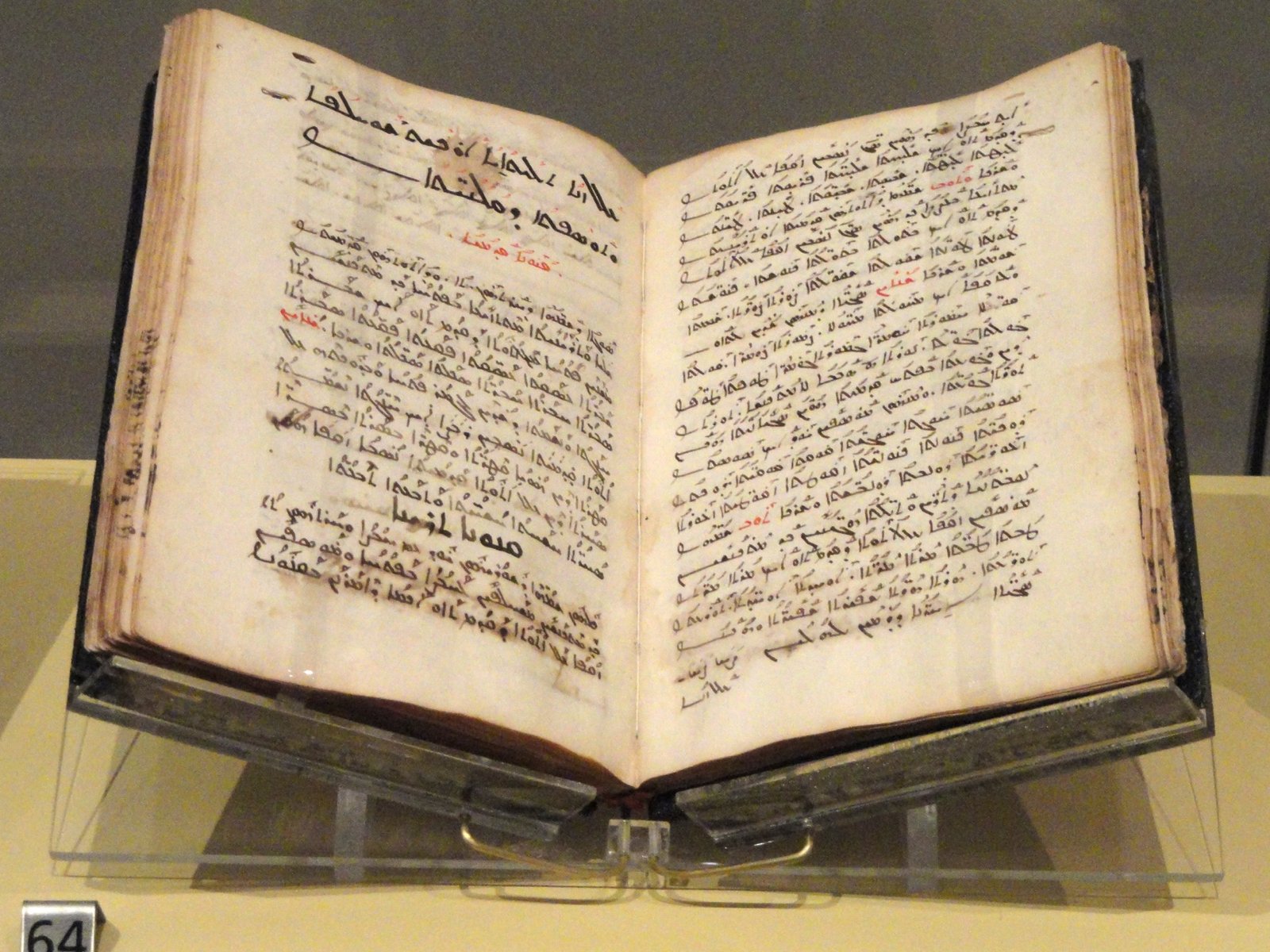
Syriac churches preserved scripture, theology, poetry, history, philosophy and science through manuscript copying across many centuries. Monasteries, villages and clerical families maintained collections under changing political conditions. Modern printing entered this established literary world; it did not introduce writing to a community without books.[1][2]
Classical Syriac and vernacular Neo-Aramaic served different but overlapping purposes. Liturgical and learned texts carried inherited prestige, while spoken varieties shaped oral poetry, storytelling and everyday communication. Nineteenth-century authors experimented with how vernacular speech could be standardised, spelled and used for new genres.[3][4]
The Urmia press and literary Neo-Aramaic
American missionaries established a press and schools in the Urmia region, but the resulting print culture depended on local clergy, teachers, translators, compositors and readers. Biblical translation, textbooks and periodicals helped develop Literary Urmia Aramaic, a written vernacular tradition sometimes called modern Assyrian or Sureth in community contexts.[3][5]
Missionary involvement brought unequal resources and evangelical aims. Local participants adopted the technology for education, argument and community projects that could exceed mission priorities. Describing this process as either pure outside invention or untouched indigenous continuity misses the interaction through which a modern public language was built.[5][6]
Newspapers and a transregional public
Periodicals allowed reports, sermons, essays, poems and political debate to circulate beyond one village or parish. Claims about a “first newspaper” require precision about language, place and format, but Urmia was unquestionably an early centre. Print linked readers in Qajar Iran to Ottoman, Russian and American networks.[6][3]
Editors created publics by selecting what counted as news and which spelling or identity terms to use. Surviving issues are rare and institutional archives incomplete. A newspaper’s title documents the editors’ language at a moment; it does not automatically represent every reader or prove one timeless national vocabulary.[6][5]
Naum Faiq and poetry of awakening
Naum Faiq, born in Diyarbekir and later active in the United States, used Syriac-language poetry and journalism to call readers toward education and collective awareness. His work belongs to the wider late Ottoman and diaspora world of reform, nationalism and new media. “Awakening” described an active modern project, not the recovery of an identity that had remained politically unchanged for millennia.[7][8]
Poetry could move between Classical Syriac learning, vernacular expression and translated political forms. It created emotional connections across church and regional boundaries while also participating in naming debates. Reading a poet historically means attending to audience, language and genre rather than extracting one line as a slogan for the present.[7][9]
War, exile and mobile presses
Sayfo and the First World War destroyed institutions and scattered writers. Print moved with refugees and migrants into Iraq, Syria, the Caucasus and the United States. Newspapers and pamphlets preserved news of lost villages, church affairs and political campaigns while helping dispersed readers imagine a community across distance.[10][11]
Assyrian printers in the United States produced work across languages and scripts for small, committed audiences. In twentieth-century Iraq, presses supported newspapers, books and cultural organisations under shifting state controls. Material scarcity, censorship and short print runs mean that today’s surviving catalogue is not a complete record of what was read.[11][12]
From journalism to digital archives
Modern Assyrian literature includes journalism, short fiction, memoir, translation, political writing, hymn, popular song and experimental poetry. East and West Syriac literary histories overlap without collapsing into one standard. Authors may publish in Neo-Aramaic, Classical Syriac, Arabic, Swedish, English or several languages.[8][13]
Digitisation makes scarce periodicals and recordings available across continents, but selection still matters. Copyright, damaged collections, uncertain cataloguing and the limited preservation of women’s and working-class writing create gaps. A complete literary history must state what the archive cannot yet show and support community-led preservation without treating digital copies as substitutes for physical stewardship.[6][14]
Evidence trail
Sources and further reading
- Holger Gzella. A Cultural History of Aramaic: From the Beginnings to the Advent of Islam. Brill, 2015.
- Anthony O’Mahony. Syriac Christianity in the Modern Middle East. The Cambridge History of Christianity, 2006.
- Heleen Murre-van den Berg. From a Spoken to a Written Language: The Introduction and Development of Literary Urmia Aramaic in the Nineteenth Century. Nederlands Instituut voor het Nabije Oosten, 1999.
- Geoffrey Khan and project team. North-Eastern Neo-Aramaic Database Project. University of Cambridge.
Documented audio and linguistic data for North-Eastern Neo-Aramaic varieties.
- Adam H. Becker. Revival and Awakening: American Evangelical Missionaries in Iran and the Origins of Assyrian Nationalism. University of Chicago Press, 2015.
Emphasises missions, education, print and modern national formation in Iran.
- Eden Naby. The Assyrians of Iran: Reunification of a “Millat,” 1906–1914. International Journal of Middle East Studies, 2006.
- Robert Isaf. Awakening, or Watchfulness: Naum Faiq and Syriac Language Poetry at the Fall of the Ottoman Empire. Brill, 2020.
- Naures Atto. Hostages in the Homeland, Orphans in the Diaspora: Identity Discourses among the Assyrian/Syriac Elites in the European Diaspora. Leiden University Press, 2011.
- John Joseph. The Modern Assyrians of the Middle East: Encounters with Western Christian Missions, Archaeologists, and Colonial Powers. Brill, 2000.
A modernist account whose arguments should be read alongside community-centred and newer scholarship.
- David Gaunt, Naures Atto and Soner O. Barthoma, eds.. Let Them Not Return: Sayfo—The Genocide Against the Assyrian, Syriac, and Chaldean Christians in the Ottoman Empire. Berghahn Books, 2017.
- J. F. Coakley. Assyrian Printers in the U.S.A., 1915–1943. ARAM Periodical.
- Daniel Benjamin. Assyrian Printing Presses in Iraq during the 20th Century. ARAM Periodical.
- Alda Benjamen. Assyrians in Modern Iraq: Negotiating Political and Cultural Space. Cambridge University Press, 2022.
- Dan Lundberg. Welcome to Assyria—Your Land on the Cyber Space. Etnomusikologia.