In brief
The essential points
- There was no single Assyrian migration: different communities left at different times under very different pressures.
- Major diaspora centres grew in Europe, North America and Australia while homeland communities continued in Iraq, Syria, Türkiye and Iran.
- Churches, clubs, language work, media and digital networks connect dispersed communities, but identity and political views remain diverse.
A diaspora made in many waves
The Assyrian diaspora is not one departure from one country. It was created through overlapping episodes of forced displacement, refugee resettlement, labour migration, study, family reunification, political repression, war and economic insecurity. A family in Chicago with roots in Urmia, a Suryoyo family in Södertälje from Tur Abdin and a household in Sydney descended from Hakkari refugees may share institutions while carrying distinct migration stories.[1][2]
“Diaspora” does not mean a people detached from the homeland. Visits, remittances, marriages, church jurisdictions, online media, village associations and political campaigns link communities across borders. At the same time, not every person wants to return, and a homeland is both lived geography and inherited attachment. The term should include people who remained as well as those who left in order to explain the relationship between them.[1][3]
Sayfo and early mass displacement
The First World War destroyed or emptied many Assyrian, Chaldean and Syriac settlements in Hakkari, Tur Abdin, Diyarbekir and Urmia-Salmas. Survivors fled toward the Caucasus, Iran, Iraq, Syria and beyond. Church leadership, manuscripts and village communities were displaced together, turning what might have been temporary refuge into permanent new geography.[4][5]
Refugees from Hakkari became especially important in British-mandate Iraq. Their military service, demands for security and failed plans for resettlement became entangled with imperial and Iraqi state politics. This history should not be generalised to all Assyrians in Iraq, many of whom had different local roots, churches and political positions.[3][2]
Simele, Iraq and the Khabur settlements
In August 1933 Iraqi army units and irregulars killed Assyrian civilians at Simele and other settlements after a political and military crisis. Death estimates and the sequence of responsibility have been contested, sometimes through denial. Recent scholarship places survivor testimony alongside British, Iraqi, American and League of Nations sources and recognises the event as a defining episode in Iraqi state formation and Assyrian memory.[3][6]
Some refugees later settled along the Khabur River in French-mandate Syria, creating villages whose names and institutions recalled Hakkari. These communities were not frozen replicas; they adapted to Syrian politics, agriculture and neighbouring populations. The Syrian war and ISIS attacks in 2015 caused renewed kidnapping, flight and dispersal.[1][2]
Post-war migration to Europe, the Americas and Australia
After the Second World War, employment, education and family networks drew migrants from Türkiye, Iraq, Iran and Syria. European guest-worker programmes and later asylum systems helped build communities in Sweden, Germany and the Netherlands. The United States and Canada received families through older networks and later refugee programmes; Australia developed substantial institutions through several waves.[1][2]
A list of cities can suggest clarity that censuses do not provide. Södertälje, Chicago, Detroit and Sydney are important hubs, but boundaries between Assyrian, Chaldean, Syriac and related categories vary by institution and dataset. Published counts may measure ancestry, language, church membership or organisational estimates. This site does not turn those unlike measures into one total.[7][8]
Iraq, Syria and the new refugee era
After 2003, bombings, kidnappings, targeted killings and general insecurity displaced Christian communities from Baghdad, Mosul and other Iraqi cities. Some moved first to the Nineveh Plains or the Kurdistan Region, then abroad. Migration decisions combined fear with employment, education, family and confidence in long-term political protection.[3][2]
In August 2014, ISIS’s advance expelled Christian and other minority populations across the Nineveh Plains. REACH and UNHCR documented mass flight at short notice, while the United States Holocaust Memorial Museum recorded ISIS crimes against minorities in Ninewa. Liberation enabled returns, but destroyed homes, contested security, uneven services and continued emigration shape recovery. The Syrian war produced parallel but locally distinct displacements.[9][10]
How diaspora institutions build community
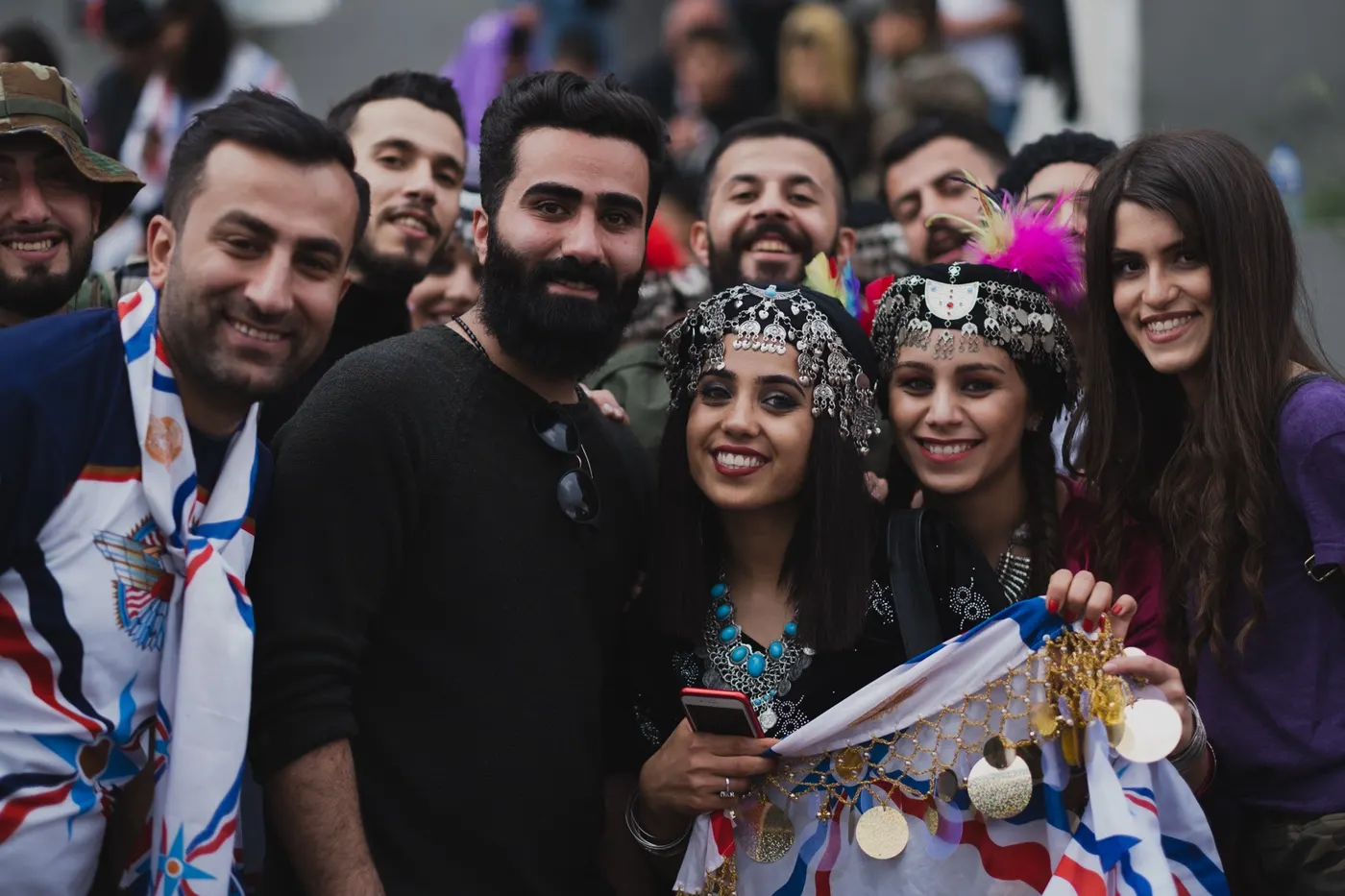
Churches often provide worship, welfare, language teaching and social gathering, but secular federations, sports clubs, student groups, women’s organisations, media outlets and village associations are equally important. Festivals and Akitu parades make identity visible in public space. Archives preserve oral testimony, photographs and community newspapers that state collections may overlook.[1][2]
Institutions also reproduce disagreement. Church calendars, political movements, dialect standards and preferred names can divide as well as connect. Diaspora conditions sometimes sharpen distinctions because organisations compete for representation; in other settings, shared vulnerability encourages compound identities and cross-church cooperation. Neither unity nor division should be assumed in advance.[1][3]
Language across generations
Migration can place speakers of previously distant Neo-Aramaic varieties in the same city while children grow up in Swedish, German, English or another majority language. Churches and classes may teach Classical Syriac or a standardised vernacular that differs from household speech. Digital keyboards, music and video make language more visible but do not guarantee everyday transmission.[11][12]
Language shift changes culture, but it does not automatically end identity. Some young adults learn a heritage language later; others participate through music, dance, food, history or activism. Successful preservation is more likely when communities welcome learners and document dialect differences instead of turning fluency into a boundary of authenticity.[13][1]
A transnational future
Diaspora communities support reconstruction, charities, cultural projects and political advocacy in the homeland. Their resources can be significant, but distance can simplify local conditions or intensify factional debate. People living in Iraq, Syria, Türkiye and Iran have their own priorities and should not be treated only as symbols for organisations abroad.[2][3]
The diaspora’s future will not be one-directional. Some people return temporarily or permanently; others build identities rooted in several countries. Digital relationships allow new collaborations across church and national boundaries. The enduring task is to preserve memory without turning culture into a display case, and to support living communities without demanding that everyone narrate belonging in the same way.[1][11]
Evidence trail
Sources and further reading
- Naures Atto. Hostages in the Homeland, Orphans in the Diaspora: Identity Discourses among the Assyrian/Syriac Elites in the European Diaspora. Leiden University Press, 2011.
- Alda Benjamen. Assyrians in Modern Iraq: Negotiating Political and Cultural Space. Cambridge University Press, 2022.
- Sargon George Donabed. Reforging a Forgotten History: Iraq and the Assyrians in the Twentieth Century. Edinburgh University Press, 2015.
- David Gaunt, Naures Atto and Soner O. Barthoma, eds.. Let Them Not Return: Sayfo—The Genocide Against the Assyrian, Syriac, and Chaldean Christians in the Ottoman Empire. Berghahn Books, 2017.
- Joseph Yacoub. Year of the Sword: The Assyrian Christian Genocide: A History. Hurst, 2016.
- Arbella Bet-Shlimon. “Propaganda of the Victims”: Atrocity Denial, Ethnic Nationalism, and the Disparagement of Assyrians in Middle East Studies. Review of Middle East Studies, 2026.
A recent critical historiographical intervention; used with, not instead of, underlying historical sources.
- United States Census Bureau. ACS Ancestry Table B04006. data.census.gov, 2020.
Uses an aggregated Assyrian/Chaldean/Syriac ancestry category.
- Australian Bureau of Statistics. Ancestry multi-response classification. 2021 Census dictionary, 2021.
Administrative ancestry codes; classifications document responses but do not settle historical relationships.
- REACH Initiative / UNHCR. Displacement of Christian Communities from Ninewa Plains, 3–7 August 2014. UNHCR data portal, 2014.
- Naomi Kikoler. “Our Generation Is Gone”: The Islamic State’s Targeting of Iraqi Minorities in Ninewa. United States Holocaust Memorial Museum, 2015.
- Geoffrey Khan and project team. North-Eastern Neo-Aramaic Database Project. University of Cambridge.
Documented audio and linguistic data for North-Eastern Neo-Aramaic varieties.
- Geoffrey Khan. Endangered dialects of Aramaic. University of Cambridge, 2008.
- Šlomo Surayt project. Surayt Aramaic Online Course. Erasmus+ language project.