In brief
The essential points
- Yes: living communities, institutions, cultural organisations and legal or census categories provide direct evidence.
- Assyrians live in Iraq, Syria, Türkiye and Iran and in large diasporas across Europe, the Americas and Australia.
- Exact population totals are uncertain because countries classify identity differently and migration, multiple ancestries and church affiliation complicate counting.
Yes—an empire can end without a people disappearing
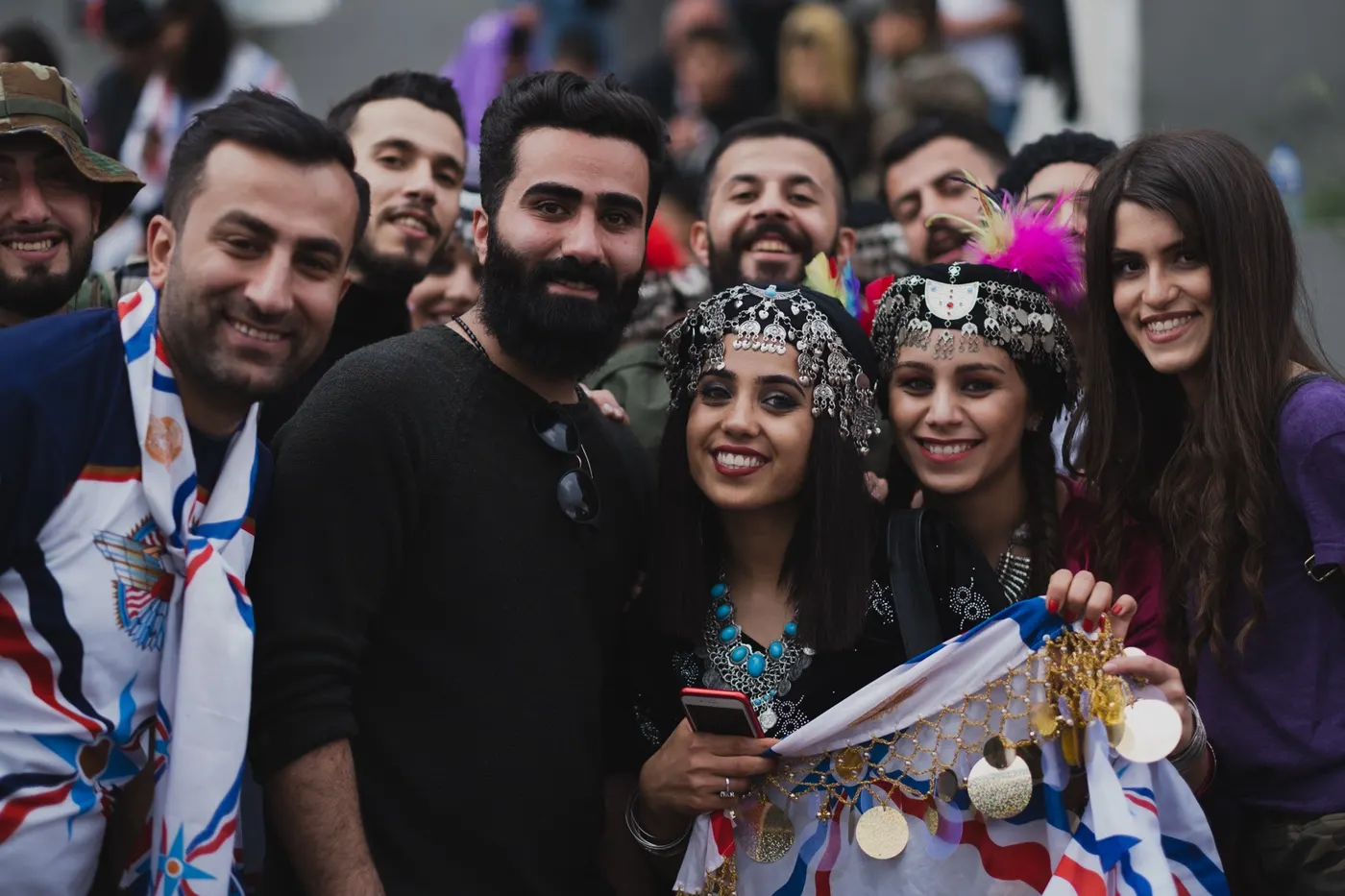
Modern Assyrians exist. They form families and congregations, publish books and media, run cultural organisations, teach languages, celebrate festivals, contest elections and identify themselves in censuses and public life. Communities remain in northern Iraq, north-eastern Syria, south-eastern Türkiye and north-western Iran, with larger or growing diasporas in countries including Sweden, Germany, the Netherlands, the United States, Canada and Australia.[1][2]
The confusion usually comes from treating a state and a population as the same thing. The Neo-Assyrian Empire was defeated between 612 and 609 BCE. Its court, army and provincial system ceased to operate. Archaeological occupation, later personal names and revived cult activity contradict the idea that every inhabitant was exterminated. Over subsequent centuries languages, religions and identities changed, as they do in every long human history.[3][4][5]
What counts as direct evidence today?
The most immediate evidence is social, not archaeological. People identify as Assyrian across more than one church and country. Assyrian schools, federations, clubs, archives, political groups, music, television, journalism and digital projects leave public records. Neo-Aramaic speakers and learners use names such as Sureth and Surayt; Classical Syriac remains important in worship and literature. None of these practices is uniform, and not every individual participates in all of them.[6][1]
State documents also record communities, though their categories differ. Iraq’s constitution names Syriac as a protected language in local administrative contexts and names Assyrians and Chaldeans in minority-rights provisions. Iran reserves one parliamentary seat for Assyrian and Chaldean Christians. The United States aggregates Assyrian/Chaldean/Syriac ancestry in one table, while Australia supplies separate ancestry codes. These classifications demonstrate visibility; they cannot settle how the labels relate.[7][8][9][10]
Where do Assyrians live?
In Iraq, Assyrian, Chaldean and Syriac communities have long histories in Baghdad, Mosul, Erbil, Kirkuk, Duhok and towns of the Nineveh Plains. In Syria, communities developed in the Khabur region, Qamishli and other cities, including descendants of refugees from Hakkari and Türkiye. Small communities persist in Tur Abdin and Istanbul, and in Tehran and Urmia in Iran. War and economic insecurity have reduced many homeland populations.[11][1]
Diaspora geography is layered. Some families arrived through early twentieth-century displacement; others moved for work and study after the Second World War; many left during conflicts in Iraq and Syria. Södertälje, Chicago, Detroit, Sydney and other centres are often mentioned, but no single city represents the diaspora. Church, village, political and language networks can connect people across national borders more strongly than physical proximity.[2][1]
Why is there no single reliable population figure?
Counting depends on the question. A census may record ancestry, ethnicity, mother tongue, religion, citizenship or only country of birth. A person can select more than one ancestry, identify differently from the church they attend, or avoid a minority label because of fear or an ill-fitting form. Some governments collect no relevant data. Refugees and undocumented migrants may be missed, while advocacy estimates may define the population more broadly than official tables.[9][10][2]
Names are another obstacle. Some people who share family, language or church histories choose Assyrian; others choose Chaldean, Syriac, Suryoyo, Aramean or a composite identity. Combining them can ignore meaningful difference; separating them completely can hide overlapping institutions and kinship. A transparent publication therefore avoids an apparently exact global total and explains whose categories a number represents.[1][12]
Does survival require speaking the heritage language?
No. Many Assyrians speak a North-Eastern Neo-Aramaic variety or Surayt/Turoyo, but language shift has been extensive. A family displaced to Baghdad might adopt Arabic; a family in Sweden may raise Swedish-dominant children; others use Kurdish, Turkish, Persian, German or English alongside a heritage variety. Ethnic belonging is a social relationship and self-identification, not a language test.[6][13]
Language loss is still a serious cultural concern. More than one hundred North-Eastern Neo-Aramaic varieties have been documented among historically Christian and Jewish communities, and many are endangered. Village destruction and dispersed speakers make intergenerational transmission difficult. Documentation, classes and media can support revival, but they do not erase differences between vernaculars or turn Classical Syriac into everyone’s household language.[13][14]
Survival does not mean uniformity
Assyrians do not share one political programme, church, spelling system, flag, account of ancestry or preferred group name. Some emphasise a direct ancient connection; others foreground Syriac Christianity or a village and church identity; many combine attachments. Diaspora generations may renegotiate labels in response to census forms, intermarriage, political movements or local institutions.[2][1]
That diversity is not evidence that the community is unreal. Comparable disagreements exist within many peoples. Modern identity formation is historical: nineteenth-century education, print, archaeology and missions influenced Assyrian nationalism, while Assyrian writers and organisers actively shaped those encounters. Showing formation does not prove fabrication; it explains how a community adapted to modern conditions.[15][11]
Continuing pressures—and cultural renewal
Violence and displacement remain central. After 2003, targeted attacks and insecurity drove Christians from Iraqi cities. In August 2014, ISIS advances expelled Christian and other minority residents across the Nineveh Plains; homes, churches and manuscripts were damaged or destroyed. Returns have occurred, but security, employment, services, property and competing authorities influence whether families remain.[16][17]
At the same time, Assyrian cultural life is not only a story of loss. Akitu processions, oral-history projects, new music, digitised manuscripts, language teaching, youth organisations and homeland reconstruction all create present-day culture. The accurate answer is therefore both simple and demanding: yes, Assyrians exist, and their communities should be understood in their contemporary complexity rather than displayed as a surviving museum fragment.[2][6]
Evidence trail
Sources and further reading
- Alda Benjamen. Assyrians in Modern Iraq: Negotiating Political and Cultural Space. Cambridge University Press, 2022.
- Naures Atto. Hostages in the Homeland, Orphans in the Diaspora: Identity Discourses among the Assyrian/Syriac Elites in the European Diaspora. Leiden University Press, 2011.
- Stefan R. Hauser. Post-Imperial Assyria. A Companion to Assyria, Wiley-Blackwell, 2017.
- Heather D. Baker. Assyrian Names. Personal Names in Cuneiform Texts from Babylonia (c. 750–100 BCE), Cambridge University Press, 2024.
Evidence for Assyrian names in post-imperial cuneiform records.
- Karen Radner. Assur’s “Second Temple Period”: The Restoration of the Cult of Aššur, c. 538 BC. Herrschaftslegitimation in vorderorientalischen Reichen der Eisenzeit, Mohr Siebeck, 2017.
Open-access study of cult and settlement after the fall of the empire.
- Geoffrey Khan and project team. North-Eastern Neo-Aramaic Database Project. University of Cambridge.
Documented audio and linguistic data for North-Eastern Neo-Aramaic varieties.
- Republic of Iraq. Constitution of the Republic of Iraq. Council of Representatives, 2005.
Articles 4 and 125 provide legal recognition relevant to language and minority rights.
- Islamic Republic of Iran. Constitution of the Islamic Republic of Iran. UN Peacemaker document repository.
Article 64 provides for an Assyrian and Chaldean Christian representative; a legal category, not a theory of identity.
- United States Census Bureau. ACS Ancestry Table B04006. data.census.gov, 2020.
Uses an aggregated Assyrian/Chaldean/Syriac ancestry category.
- Australian Bureau of Statistics. Ancestry multi-response classification. 2021 Census dictionary, 2021.
Administrative ancestry codes; classifications document responses but do not settle historical relationships.
- Sargon George Donabed. Reforging a Forgotten History: Iraq and the Assyrians in the Twentieth Century. Edinburgh University Press, 2015.
- Catholic Near East Welfare Association. The Chaldean Catholic Church. Eastern Christian Churches.
- Geoffrey Khan. Endangered dialects of Aramaic. University of Cambridge, 2008.
- Šlomo Surayt project. Surayt Aramaic Online Course. Erasmus+ language project.
- Adam H. Becker. Revival and Awakening: American Evangelical Missionaries in Iran and the Origins of Assyrian Nationalism. University of Chicago Press, 2015.
Emphasises missions, education, print and modern national formation in Iran.
- REACH Initiative / UNHCR. Displacement of Christian Communities from Ninewa Plains, 3–7 August 2014. UNHCR data portal, 2014.
- Naomi Kikoler. “Our Generation Is Gone”: The Islamic State’s Targeting of Iraqi Minorities in Ninewa. United States Holocaust Memorial Museum, 2015.