In brief
The essential points
- Assyrians are not only the subjects of an ancient empire; self-identifying Assyrian communities live in the Middle East and around the world.
- Many inherit Neo-Aramaic languages and Syriac Christian traditions, but no one church, dialect or political position defines everyone.
- The relationship between ancient and modern Assyrians includes survival and transformation; its exact forms should be investigated rather than reduced to slogans.
The short answer
Assyrians are a present-day people historically rooted in northern Mesopotamia, especially regions now divided among Iraq, Syria, Türkiye and Iran. Large communities also live in Europe, North America, Australia and elsewhere. Many Assyrians inherit varieties of Neo-Aramaic, use Syriac in worship or literature, and maintain churches, clubs, media, archives, music and family networks. Others primarily speak the languages of the countries where they live. Language fluency, church membership and citizenship do not by themselves decide identity.[1][2]
The same word also names people associated with the ancient city, kingdom and empire of Ashur. These are related subjects, not identical snapshots. Ancient Assyrians lived in societies whose institutions, languages and categories changed across two millennia. Modern Assyrian identity developed through later northern Mesopotamian histories, Christian traditions, regional memories, print, migration and national politics. A responsible introduction holds connection and change together.[3][4]
Who counted as Assyrian in antiquity?
In early periods “Assyrian” could centre on citizenship in Ashur, participation in its commercial institutions and obligations to its god. Middle Assyrian expansion turned a city-centred polity into a territorial kingdom. The Neo-Assyrian Empire then incorporated many populations, languages and local traditions. Officials, soldiers, farmers and deported communities entered an unequal imperial order; “Assyrian” was a political and social category, not a modern biological race.[3][5]
Akkadian in an Assyrian dialect was central to ancient administration and royal inscriptions, written in cuneiform. Sumerian and Babylonian learning were also prestigious, and Aramaic became increasingly widespread. The empire’s defeat between 612 and 609 BCE ended its dynasty and central institutions. It did not annihilate every inhabitant of the heartland. Later settlement, names and cultic evidence show survival amid profound political and linguistic change.[6][7][8]
Historic homelands and shared geography
Modern Assyrian histories are tied to a broad northern Mesopotamian and neighbouring highland landscape: the Nineveh Plains and cities of Iraq; the Hakkari mountains and Tur Abdin in present-day Türkiye; the Urmia plain of Iran; and parts of north-eastern Syria. These regions were never sealed ethnic containers. Assyrians lived beside Kurdish, Arab, Armenian, Turkish, Persian, Jewish, Yazidi and other neighbours, with relationships ranging from trade and protection to competition and violence.[9][10]
Modern borders cut across older ecclesiastical, family, market and migration networks. They also do not reproduce the outline of any single ancient Assyrian reign. Saying that a place forms part of an Assyrian historical homeland describes durable community attachment; it does not erase other peoples’ connections or turn every ancient imperial frontier into a present territorial claim.[2][1]
Languages: from Akkadian to Neo-Aramaic
Ancient Assyrians spoke Akkadian, while Aramaic spread across the empire and the wider Near East. Aramaic is a related Semitic language, not a descendant of Akkadian. In late antiquity the Aramaic variety of Edessa became Classical Syriac, a major literary and liturgical language. Modern heritage speech includes diverse North-Eastern Neo-Aramaic varieties and Surayt/Turoyo; these are living developments, not unchanged forms of ancient imperial Akkadian.[11][12]
Community names for language—Sureth, Surayt, Suryoyo, Assyrian, Syriac and others—do not map perfectly onto academic categories. Many varieties are endangered because violence and migration broke village networks and diaspora generations often shift toward majority languages. Yet new dictionaries, recordings, classes, music and digital media also sustain them. An Assyrian who speaks Arabic, Kurdish, Swedish or English is not thereby less Assyrian.[13][14]
Church traditions are important—and not identical to ethnicity
Assyrians may belong to the Assyrian Church of the East, Ancient Church of the East, Chaldean Catholic Church, Syriac Orthodox Church, Syriac Catholic Church, Protestant churches or other communities; some are secular or nonreligious. These institutions preserved liturgy, manuscripts, education and social life, especially in periods without a state. Their histories also include schisms, unions and regional differences.[4][15]
No church has a single ethnic membership, and no ethnicity is reducible to one church. Many Chaldean Catholics identify ethnically as Chaldean; others identify as Assyrian or use composite terms. Many West Syriac Christians identify as Syriac, Suryoyo, Aramean, Assyrian or in other ways. Editorial neutrality means describing these positions accurately and respecting how people name themselves, not assigning an identity through denomination.[2][1]
A compressed modern history
During the nineteenth century, missions, schools, printing and new travel connected communities across Urmia, Hakkari, Ottoman cities and foreign centres. Local writers and clergy participated actively; Western institutions did not simply invent identity for passive recipients. Archaeological discoveries made ancient Assyria newly visible at the same time that Ottoman reform, church politics and global national movements changed the terms of public belonging.[10][16]
The First World War brought Sayfo: mass killing, expulsion, abduction, starvation and flight across Hakkari, Tur Abdin, Diyarbekir and the Urmia-Salmas region. Survivors rebuilt in Iraq, Syria, Iran and the diaspora. In 1933 Iraqi forces and irregulars killed Assyrian civilians at Simele and other settlements. Later wars, repression and economic migration produced further diasporas; ISIS’s 2014 offensive displaced communities from the Nineveh Plains and destroyed heritage.[17][9][18]
Assyrians today
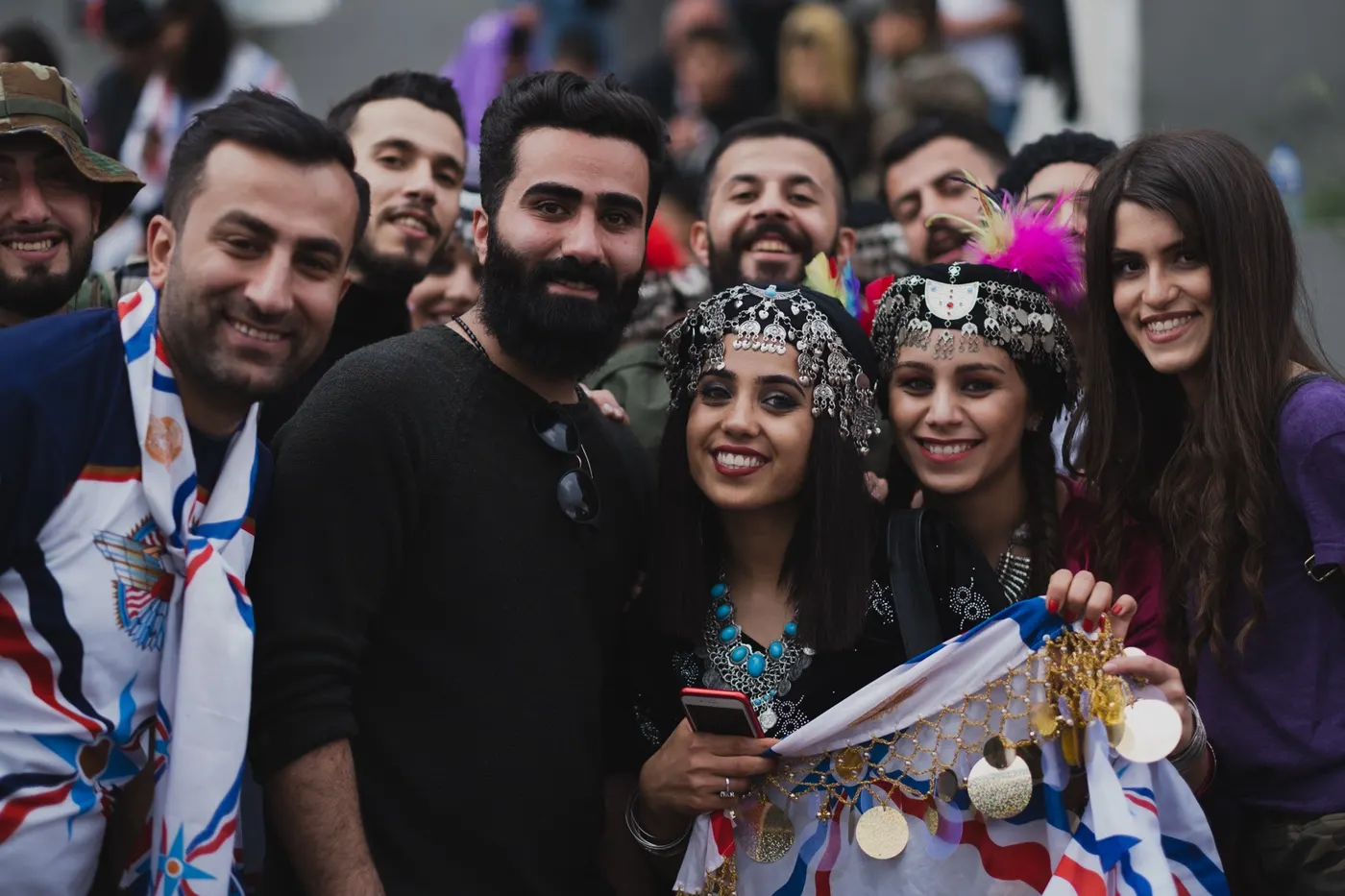
Today Assyrian life is local and transnational. Villages and urban neighbourhoods remain in Iraq, Syria, Türkiye and Iran, while diaspora hubs support churches, schools, clubs, broadcasters, publishers, dance groups and archives. Akitu celebrations bring history into public space. Families send remittances, visit ancestral towns, debate political futures and maintain relationships across several countries.[2][1]
There is no universally reliable world population total. Censuses may combine or separate Assyrian, Chaldean and Syriac responses; many states do not record ethnicity; displacement is fluid; and church membership is not the same as ancestry. The most accurate answer begins with existence rather than numbers: Assyrians are a living, internally diverse people whose history includes an ancient empire but is not confined to it.[19][20][21]
Evidence trail
Sources and further reading
- Alda Benjamen. Assyrians in Modern Iraq: Negotiating Political and Cultural Space. Cambridge University Press, 2022.
- Naures Atto. Hostages in the Homeland, Orphans in the Diaspora: Identity Discourses among the Assyrian/Syriac Elites in the European Diaspora. Leiden University Press, 2011.
- Jonathan Valk. Ancient Assyrians: Identity and Society in Antiquity and Beyond. Cambridge University Press, 2025.
A study of Assyrian social categories that cautions against projecting modern identity models unchanged into antiquity.
- Aaron Michael Butts. Assyrian Christians. A Companion to Assyria, Wiley-Blackwell, 2017.
- Karen Radner. Ancient Assyria: A Very Short Introduction. Oxford University Press, 2015.
A concise scholarly synthesis of Assyrian geography, society and imperial history.
- Silvie Zamazalová. Aramaic and Hebrew in Alphabetic Scripts. The Nimrud Project, ORACC.
- Stefan R. Hauser. Post-Imperial Assyria. A Companion to Assyria, Wiley-Blackwell, 2017.
- Heather D. Baker. Assyrian Names. Personal Names in Cuneiform Texts from Babylonia (c. 750–100 BCE), Cambridge University Press, 2024.
Evidence for Assyrian names in post-imperial cuneiform records.
- Sargon George Donabed. Reforging a Forgotten History: Iraq and the Assyrians in the Twentieth Century. Edinburgh University Press, 2015.
- Adam H. Becker. Revival and Awakening: American Evangelical Missionaries in Iran and the Origins of Assyrian Nationalism. University of Chicago Press, 2015.
Emphasises missions, education, print and modern national formation in Iran.
- Holger Gzella. A Cultural History of Aramaic: From the Beginnings to the Advent of Islam. Brill, 2015.
- Geoffrey Khan and project team. North-Eastern Neo-Aramaic Database Project. University of Cambridge.
Documented audio and linguistic data for North-Eastern Neo-Aramaic varieties.
- Geoffrey Khan. Endangered dialects of Aramaic. University of Cambridge, 2008.
- Šlomo Surayt project. Surayt Aramaic Online Course. Erasmus+ language project.
- Catholic Near East Welfare Association. The Chaldean Catholic Church. Eastern Christian Churches.
- Heleen Murre-van den Berg. From a Spoken to a Written Language: The Introduction and Development of Literary Urmia Aramaic in the Nineteenth Century. Nederlands Instituut voor het Nabije Oosten, 1999.
- David Gaunt, Naures Atto and Soner O. Barthoma, eds.. Let Them Not Return: Sayfo—The Genocide Against the Assyrian, Syriac, and Chaldean Christians in the Ottoman Empire. Berghahn Books, 2017.
- REACH Initiative / UNHCR. Displacement of Christian Communities from Ninewa Plains, 3–7 August 2014. UNHCR data portal, 2014.
- Republic of Iraq. Constitution of the Republic of Iraq. Council of Representatives, 2005.
Articles 4 and 125 provide legal recognition relevant to language and minority rights.
- United States Census Bureau. ACS Ancestry Table B04006. data.census.gov, 2020.
Uses an aggregated Assyrian/Chaldean/Syriac ancestry category.
- Australian Bureau of Statistics. Ancestry multi-response classification. 2021 Census dictionary, 2021.
Administrative ancestry codes; classifications document responses but do not settle historical relationships.