In brief
The essential points
- There was no single Assyrian rise: commercial, territorial and imperial phases were separated by contraction and recovery.
- The empire combined coercion with roads, provincial government, elite incorporation, planned cities and mass resettlement.
- Babylonian and Median military success caused the final defeat; succession problems, multiple fronts and possible climate stress shaped vulnerability.
There was more than one Assyrian rise
Assyria’s ascent was not a straight line from a small town to a world empire. Old Assyrian merchants created an influential commercial network without conquering Anatolia. Middle Assyrian kings built a territorial state in the Late Bronze Age, then lost much of its outer reach. Neo-Assyrian rulers recovered old districts during the early first millennium BCE before expanding into places their predecessors had never governed directly. Each phase drew on older institutions while responding to a different political landscape.[1][2]
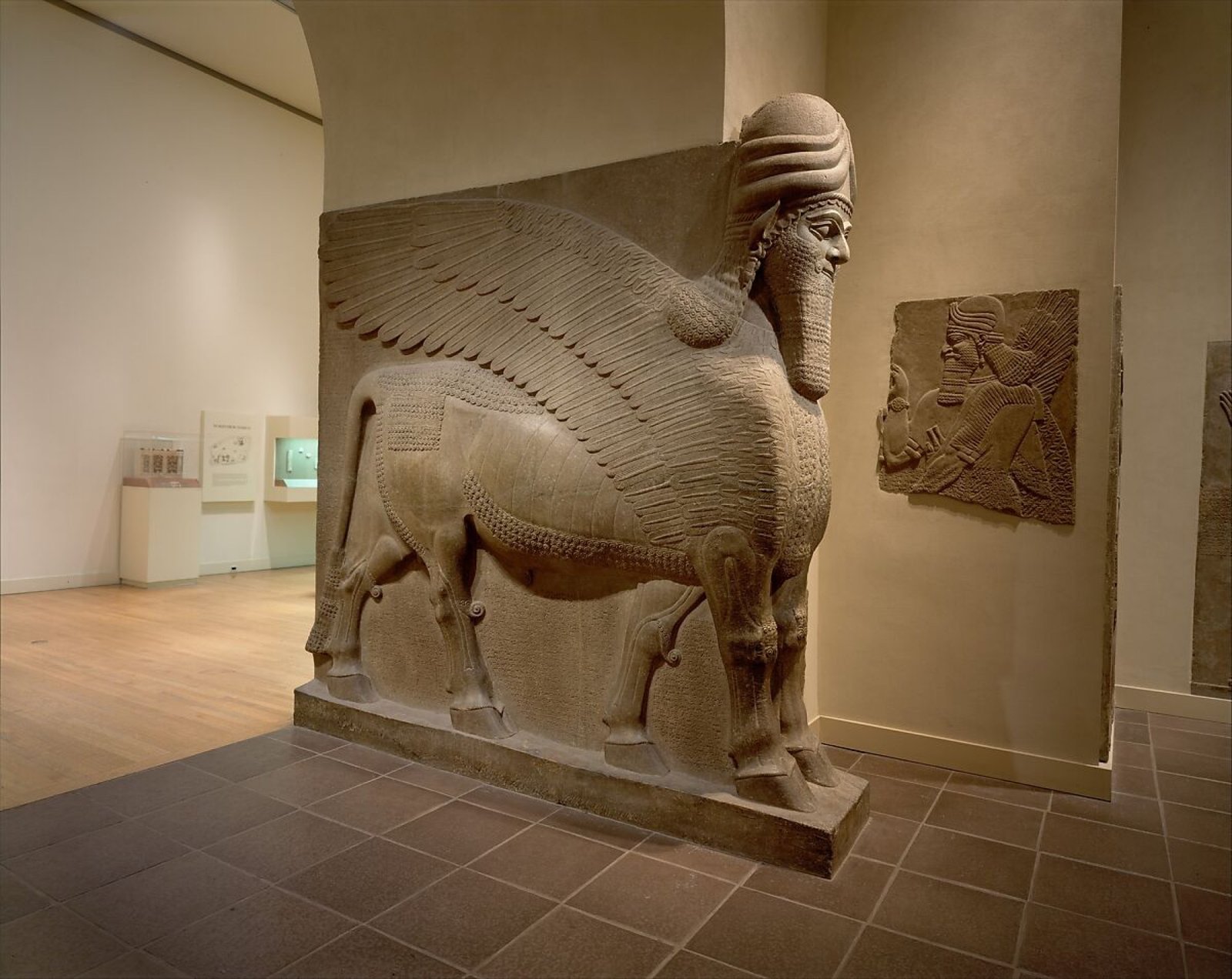
This long view corrects two tempting stories. The Neo-Assyrian Empire did not appear suddenly because one king invented an army, and its power cannot be explained only by a taste for conquest. Agricultural resources, provincial administration, taxation, transport, scribal records, diplomacy and the ability to move people and supplies all mattered. The spectacle of royal reliefs shows how rulers wanted empire to look; archives show the continuous work that made it function.[5][4]
Recovery, routes and a new capital
In the tenth and ninth centuries BCE, kings including Ashur-dan II and Adad-nirari II restored Assyrian authority in the Tigris heartland and along routes toward the Khabur and Euphrates. Campaigns sought taxes, livestock, labour and strategic corridors, but they also re-established cultivated land and fortified settlements. Recovery accumulated across reigns. It did not depend on one decisive battle.[1][2]
Ashurnasirpal II made Kalhu the principal court city. Its palace, temples and storage areas concentrated officials and goods, while carved walls turned ceremonies into lessons about royal order. The king’s inscriptions openly describe exemplary violence. Those acts were real instruments of intimidation, yet the texts were also curated political theatre. Assyria was not the only ancient empire to use terror or deportation, and comparison is more revealing than the slogan that it was uniquely brutal.[3][5]
From tribute to direct government
Shalmaneser III pushed Assyrian armies toward Syria and Anatolia, receiving tribute from many rulers. Tribute could acknowledge temporary superiority without ending local kingship. The coalition that met him at Qarqar in 853 BCE survived his claimed victory, and repeated campaigns show that western politics could not simply be settled by inscription. The later ninth and early eighth centuries also saw powerful Assyrian magnates exercise considerable regional authority, testing the balance between court and provinces.[3][2]
Tiglath-Pileser III, who took power in 745, accelerated a shift toward annexation. Conquered kingdoms were more often divided into provinces under appointed governors; military resources and correspondence were coordinated more tightly; and smaller jurisdictions reduced some officials’ independence. These were transformations of existing practices rather than inventions from nothing. They made the empire more governable at scale, but also increased the centre’s responsibility for distant territories.[4][1]
Coercion, resettlement and incorporation
Assyrian kings moved hundreds of thousands of people over the course of the imperial period, although figures in individual royal texts require caution. Deportation meant dispossession, family disruption, forced travel and risk of death. It was not identical to a policy of extermination: the state often intended resettled communities to farm, build, serve in armies or practise skilled trades elsewhere. That combination of violence and incorporation is central to understanding the empire’s population.[1][2]
The result was a multilingual society. Akkadian remained important for royal and scholarly writing, while Aramaic spread through administration and daily communication. Provincial and vassal elites could enter imperial service. Roads, relay systems and letters connected local officials to the court, though communication was never instantaneous and regional interests persisted. Empire was an unequal structure, but it was not a simple division between one biologically defined people and everyone else.[6][5]
The Sargonid empire at its height
Sargon II secured the throne after Shalmaneser V and spent years suppressing resistance. He founded Dur-Sharrukin as a formal expression of a new dynasty, but died in battle soon after its inauguration. Sennacherib moved the court to Nineveh, invested in water systems and palaces, campaigned in Judah and pursued repeated wars over Babylonia. His destruction of Babylon in 689 was an exceptional act within a long relationship of rivalry, reverence and shared scholarly culture.[4][7]
Esarhaddon reversed that policy by rebuilding Babylon and took Memphis in 671, though Egypt remained difficult to hold. Ashurbanipal’s forces later sacked Thebes and fought in Elam. The empire looked dominant, but his war against his brother Shamash-shumu-ukin of Babylon from 652 to 648 was a civil conflict across the imperial system. Victory was costly, and the evidence for the following two decades becomes unusually damaged and difficult to order.[4][9]
The final war, 626–609 BCE
After Ashurbanipal, short reigns and contested succession weakened the royal centre. Nabopolassar established an independent Babylonian regime in 626. The war initially moved back and forth, but Babylonian forces and their Median allies eventually attacked the heartland. The Medes captured Ashur in 614; the combined armies took Nineveh in 612 after a siege. The court and army withdrew west rather than disappearing in a single night.[8][9]
Harran fell in 610. In 609 BCE an Assyrian remnant supported by Egypt tried and failed to recover it. That is the clearest end point for organised Assyrian kingship. The proximate cause of collapse is therefore not mysterious: hostile armies defeated Assyria, captured its major centres and prevented restoration. What historians debate is why the imperial system could no longer absorb a challenge of the kind it had survived before.[8][2]
Why did the empire become vulnerable?
Several contextual factors have stronger support than a one-cause explanation. The civil war over Babylon consumed resources and damaged trust. Succession after Ashurbanipal was unstable. Assyria faced simultaneous pressure in its core and on western routes, while the loss of provinces reduced revenue and manpower. Babylonia offered the coalition a powerful political centre with its own legitimacy and experience of Assyrian rule.[9][2]
Researchers have also proposed fiscal and demographic overextension and a severe multidecadal drought. Climate records can identify environmental stress, but they cannot by themselves show how officials, farmers or armies responded in every region; the drought argument should be attributed, not turned into consensus. Nor does the claim that Assyrian cruelty inevitably united every subject fit the varied alliances and long chronology. Military defeat, internal disruption and external coalition remain the safest combined explanation.[10][9]
What fell—and what did not
The dynasty, capital network and central administration ceased to operate. Palaces were looted or destroyed, archives scattered and an imperial political identity lost its institutional centre. Those changes were profound. They do not prove that every local community was killed, deported or suddenly stripped of memory. Farms, towns, cult practices and family lines continued unevenly across the region.[11][12]
Later periods brought new rulers, languages and religions. Continuity was selective and transformation constant. That distinction matters for modern questions: the fall of a state is not demographic extinction, but neither is survival evidence that imperial society remained unchanged. The Assyrian case is most interesting when collapse and persistence are studied together.[13][14]
Evidence trail
Sources and further reading
- Karen Radner. Ancient Assyria: A Very Short Introduction. Oxford University Press, 2015.
A concise scholarly synthesis of Assyrian geography, society and imperial history.
- Eckart Frahm, ed.. A Companion to Assyria. Wiley-Blackwell, 2017.
Specialist chapters covering Assyrian history, language, cities, institutions and later reception.
- A. Kirk Grayson and project editors. Royal Inscriptions of Assyria online. Open Richly Annotated Cuneiform Corpus, University of Pennsylvania.
Scholarly editions and translations for Assyrian royal inscriptions through 745 BCE.
- Grant Frame, director. Royal Inscriptions of the Neo-Assyrian Period. Open Richly Annotated Cuneiform Corpus, University of Pennsylvania.
Searchable scholarly editions and translations of royal inscriptions; these texts are royal political compositions, not neutral chronicles.
- Joan Aruz, Sarah B. Graff and Yelena Rakic, eds.. Assyria to Iberia at the Dawn of the Classical Age. The Metropolitan Museum of Art, 2014.
Museum scholarship on Assyrian art, imperial imagery and interregional exchange.
- Silvie Zamazalová. Aramaic and Hebrew in Alphabetic Scripts. The Nimrud Project, ORACC.
- Eckart Frahm. The Great City: Nineveh in the Age of Sennacherib. Journal of the Canadian Society for Mesopotamian Studies 3, 2008.
- British Museum. Fall of Nineveh Chronicle, BM 21901. British Museum collection.
Babylonian chronicle covering the decisive campaigns of 616–609 BCE.
- Simonetta Ponchia. The End of the Neo-Assyrian Empire. The End of Empires, Springer Nature, 2022.
Reviews sparse late evidence and competing explanations for imperial collapse.
- Ashish Sinha et al.. Role of climate in the rise and fall of the Neo-Assyrian Empire. Science Advances 5(11), 2019.
A climate-vulnerability argument that remains one factor in a broader scholarly debate.
- Stefan R. Hauser. Post-Imperial Assyria. A Companion to Assyria, Wiley-Blackwell, 2017.
- Karen Radner. Assur’s “Second Temple Period”: The Restoration of the Cult of Aššur, c. 538 BC. Herrschaftslegitimation in vorderorientalischen Reichen der Eisenzeit, Mohr Siebeck, 2017.
Open-access study of cult and settlement after the fall of the empire.
- Heather D. Baker. Assyrian Names. Personal Names in Cuneiform Texts from Babylonia (c. 750–100 BCE), Cambridge University Press, 2024.
Evidence for Assyrian names in post-imperial cuneiform records.
- Jonathan Valk. Ancient Assyrians: Identity and Society in Antiquity and Beyond. Cambridge University Press, 2025.
A study of Assyrian social categories that cautions against projecting modern identity models unchanged into antiquity.