In brief
The essential points
- Nineveh stood on the east bank of the Tigris opposite modern Mosul and had a long history before it became an imperial capital.
- Sennacherib transformed it with a palace, walls, gates, canals, gardens and regional waterworks.
- The city was captured in 612 BCE, but later occupation and memory continued; nineteenth-century excavations took place within a living regional landscape.
A city opposite Mosul
The ruins of Nineveh lie on the east bank of the Tigris within modern Mosul. Two principal mounds, Kuyunjik and Nebi Yunus, rise above a large lower city enclosed in the imperial period by roughly twelve kilometres of wall. The walled area covered around 750 hectares, but population estimates vary too widely to present as fact. A coordinate for Kuyunjik locates one mound; it does not define the whole ancient urban landscape.[1][2]
Nineveh is also the name of a modern Iraqi governorate, much larger than the archaeological city. Distinguishing site, metropolis and province prevents confusion. The landscape contains neighbourhoods, roads, shrines and communities whose histories did not begin with excavation. Heritage management therefore involves archaeology, urban life, religious significance, conflict damage and the rights of people who live beside and upon ancient layers.[3][12]
Older than the Assyrian Empire
Occupation at Kuyunjik reaches back into prehistory. By the second millennium BCE Nineveh was an important religious centre of the goddess Ishtar, whose cult attracted royal attention from Assyrian and neighbouring rulers. Middle Assyrian and early Neo-Assyrian kings repaired temples and built there. It is therefore wrong to describe Nineveh as a new city created by Sennacherib or to make its identity depend entirely on the final century of empire.[1][3]
Its location brought access to the Tigris, nearby plains and routes east toward Arbela and the Zagros. Yet an ancient city was more than strategic ground: temples, markets, workshops, households and burial practices accumulated across centuries. Much remains difficult to recover because later construction, early excavation methods and modern urban use disturbed parts of the record.[2][3]
Sennacherib’s “Palace Without Rival”
After Sargon II died in 705 BCE, Sennacherib abandoned Dur-Sharrukin as the main royal residence and made Nineveh the centre of his reign. The Southwest Palace occupied the citadel at Kuyunjik. Its carved rooms presented campaigns, building works and the ordered movement of tribute. The famous reliefs of the siege of Lachish transformed a western campaign into a controlled visual sequence for audiences inside the court.[4][1]
Sennacherib also enlarged walls, monumental gates and streets. Inscriptions describe creating a city worthy of kingship, but they should not be read as if nothing existed before him. His project reworked an old place at enormous scale. The labour, materials and displaced people required for construction linked the splendour of the capital to the unequal resources of empire.[4][5]
Water, gardens and regional engineering
Canals brought water from distant catchments to Nineveh’s fields and gardens. At Jerwan, a monumental stone aqueduct carried one channel across a valley. These works supported agriculture and urban life while announcing the king’s ability to reorder landscape. Inscriptions celebrate abundant orchards and exotic plants, but the system also depended on local topography, maintenance and communities along its route.[1][2]
Stephanie Dalley has argued that later traditions of Babylon’s Hanging Gardens may preserve memory of Sennacherib’s gardens at Nineveh. The theory is prominent and ingenious, not settled fact. No single archaeological feature conclusively identifies the classical wonder, and the relevant Greek and cuneiform sources raise difficult questions of translation, place and transmission.[3]
Ashurbanipal’s court and collections
Ashurbanipal built and decorated the North Palace. Reliefs of royal lion hunts combine observed anatomy, controlled sequence and violent kingship; war scenes depict the defeat of Elam and other campaigns. They are extraordinary works of art and arguments about authority, not photographic records. Their survival in museums reflects both ancient destruction and nineteenth-century removal.[6][5]
The tablet collections excavated at Nineveh include scholarly, literary, medical, divinatory, lexical and administrative texts. Calling them Ashurbanipal’s Library is convenient, but the phrase gathers material from several rooms, institutions and histories. The tablets matter not only because famous works such as Gilgamesh appeared among them, but because they preserve the everyday practices of copying, checking, advising and interpreting at court.[7][8]
The siege and fall of 612 BCE
A Babylonian-Median coalition besieged and captured Nineveh in 612 BCE. The Babylonian chronicle supplies the essential sequence, while burn layers, scattered sculpture and damaged tablets offer archaeological evidence. Later retellings sometimes add a sudden flood or total annihilation. The sources justify a destructive conquest, not the claim that every inhabitant died or that the entire enclosed city was erased at once.[9][10]
Assyrian forces continued from Harran until their failed counteroffensive in 609. Nineveh lost its role as an imperial capital, and parts of its monumental centre became ruins. Later settlement occurred in Hellenistic, Parthian, Sasanian and Islamic periods at changing scale. “Fallen” and “uninhabited forever” are not synonyms.[11][3]
Memory, excavation and colonial collecting
Biblical books and classical authors preserved powerful memories of Nineveh as a vast, proud and morally charged city. Those works are evidence for later interpretation as well as, in some cases, historical comparison. The Book of Jonah’s “three days’ journey” should not be converted into a modern survey measurement or population figure. Literary scale serves literary purpose.[3]
European-sponsored excavation began at Kuyunjik in the 1840s. Austen Henry Layard exposed parts of Sennacherib’s palace, and the Mosul-born archaeologist Hormuzd Rassam uncovered Ashurbanipal’s North Palace in 1853. Local workers made the discoveries possible but were often marginalised in published narratives. Objects entered collections in London and elsewhere under imperial conditions, and early digging sacrificed information about precise contexts that researchers now work to reconstruct.[7][1]
Nineveh today
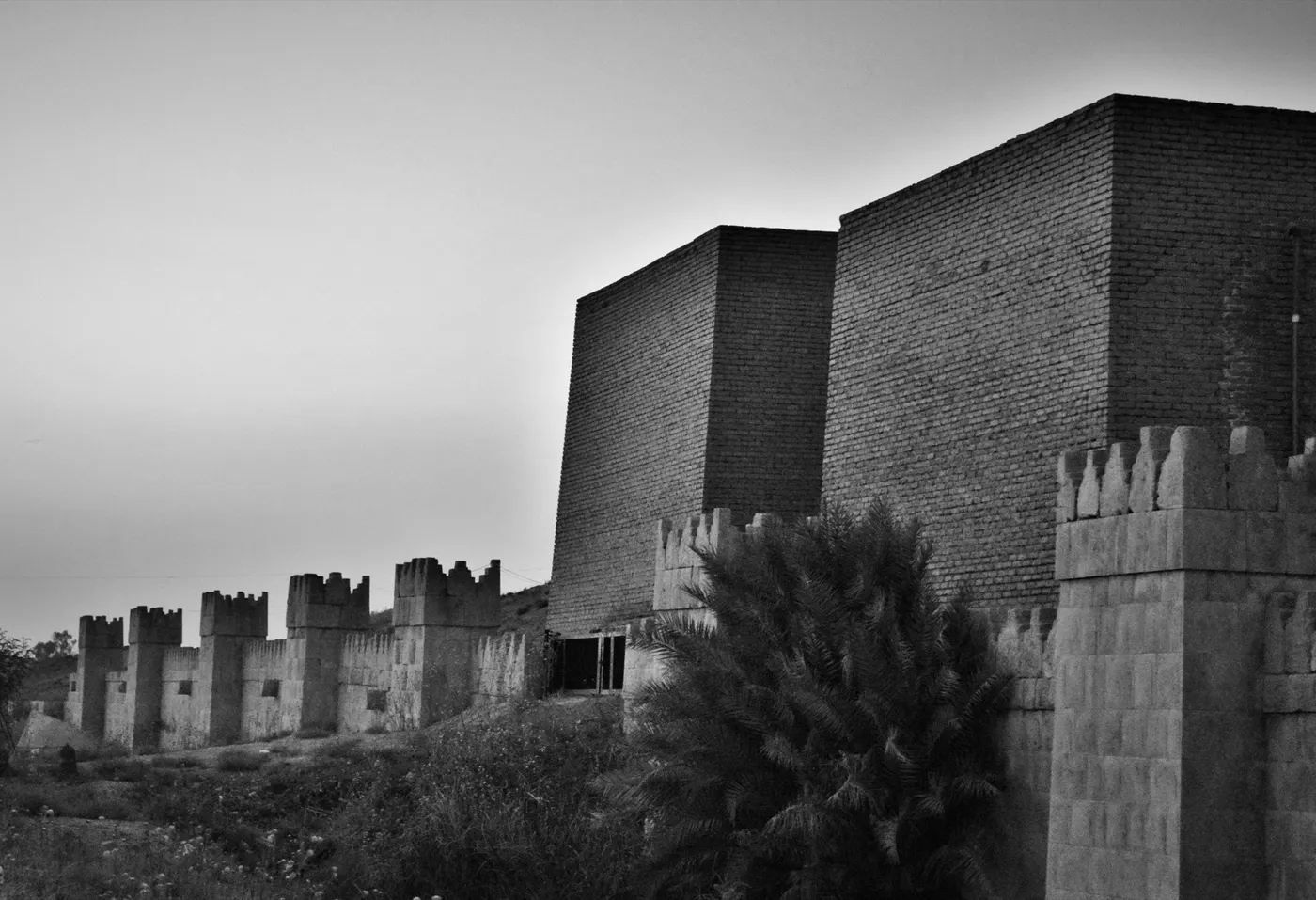
The site suffered neglect, looting and deliberate destruction during recent conflict. ISIS destroyed the Mashki Gate and damaged Nebi Yunus; documentation and Iraqi-led reconstruction have since reopened possibilities for research and public access. Restoration must distinguish original fabric, documented reconstruction and new intervention so visitors can understand what they are seeing.[12]
Nineveh remains more than a ruin. It is a world heritage concern, a landmark within Mosul and a place connected to Assyrian and wider Iraqi histories. Treating it responsibly means crediting Iraqi institutions and communities, recording damage without sensationalism, and recognising that the story of archaeology is part of the site’s history rather than a neutral epilogue.[3]
Evidence trail
Sources and further reading
- Eckart Frahm. The Great City: Nineveh in the Age of Sennacherib. Journal of the Canadian Society for Mesopotamian Studies 3, 2008.
- Karen Radner. Ancient Assyria: A Very Short Introduction. Oxford University Press, 2015.
A concise scholarly synthesis of Assyrian geography, society and imperial history.
- Eckart Frahm, ed.. A Companion to Assyria. Wiley-Blackwell, 2017.
Specialist chapters covering Assyrian history, language, cities, institutions and later reception.
- Grant Frame, director. Royal Inscriptions of the Neo-Assyrian Period. Open Richly Annotated Cuneiform Corpus, University of Pennsylvania.
Searchable scholarly editions and translations of royal inscriptions; these texts are royal political compositions, not neutral chronicles.
- Joan Aruz, Sarah B. Graff and Yelena Rakic, eds.. Assyria to Iberia at the Dawn of the Classical Age. The Metropolitan Museum of Art, 2014.
Museum scholarship on Assyrian art, imperial imagery and interregional exchange.
- British Museum. Who was Ashurbanipal?. British Museum blog, 2018.
- Jon Taylor and project team. What was Ashurbanipal’s Library?. British Museum research project, 2020–2024.
Research on the size, origins, colophons and archaeological contexts of the Nineveh tablet collections.
- British Museum and LMU Munich. Reading the Library of Ashurbanipal. Open Richly Annotated Cuneiform Corpus, 2022–.
Project documentation and editions for the Nineveh scholarly collections.
- British Museum. Fall of Nineveh Chronicle, BM 21901. British Museum collection.
Babylonian chronicle covering the decisive campaigns of 616–609 BCE.
- Simonetta Ponchia. The End of the Neo-Assyrian Empire. The End of Empires, Springer Nature, 2022.
Reviews sparse late evidence and competing explanations for imperial collapse.
- Stefan R. Hauser. Post-Imperial Assyria. A Companion to Assyria, Wiley-Blackwell, 2017.
- UNESCO World Heritage Centre. Ashur (Qal’at Sherqat). World Heritage List, 2003–.
Site history, significance and conservation status.