In brief
The essential points
- Ancient Assyrian religion belonged to a wider Mesopotamian polytheistic world and was never monotheistic or static.
- Aššur linked city, territory and kingship, while Ishtar, Sîn, Shamash, Adad, Nabu and many other deities had major cults.
- Divination, medicine and protective ritual were learned practices in their historical intellectual system, not decorative superstition.
Aššur: god, city and political centre
Aššur shared his name with Assyria’s oldest city and eventually with the land ruled from it. Early evidence gives the deity less developed family mythology than gods such as Enlil or Marduk. As Assyrian power expanded, royal theology presented conquest and government as service to Aššur. The king was the god’s steward and representative, not normally a god himself.[1][2]
Aššur’s pre-eminence did not erase other gods or make Assyrian religion monotheistic. Royal texts adapted established Mesopotamian language, and the god could absorb attributes associated with Enlil. Political prominence changed theological expression across time. What appears to be one stable “national god” was therefore an institution continually interpreted by priests, scholars and kings.[1][5]
A diverse Mesopotamian pantheon
Ishtar of Nineveh and Ishtar of Arbela were powerful local manifestations associated with war, love, prophecy and royal protection. Sîn’s sanctuary at Harran, Shamash’s connection with justice and divination, Adad’s storms, Ninurta’s warrior qualities and Nabu’s scribal learning all mattered. Babylonian cults and scholarly traditions remained deeply influential even during political rivalry.[2][1]
Local identity was important: a deity’s form at one city was not always interchangeable with the same divine name elsewhere. Temples maintained calendars, offerings and inherited traditions. Imperial movement also carried cults, objects and specialists between cities. The result was neither a closed Assyrian system nor a generic religion identical across all Mesopotamia.[1][3]
Temples as ritual, economic and scholarly institutions
Temples housed divine images, received offerings and staged festivals, but they were also employers, landholders, archives and centres of craft production. Priests and administrators managed food, textiles, precious materials and personnel. A temple’s economic role served ritual obligations and institutional survival rather than operating as a separate secular corporation.[1][5]
Kings restored temples to demonstrate piety, legitimacy and command of resources. Building inscriptions describe ancient foundations discovered and renewed according to divine order. Such claims were political, yet the work itself could be substantial. Archaeology reveals repeated rebuilding, showing how each generation preserved the past by altering its material form.[6][7]
Kingship, festival and divine approval
Royal ceremonies connected the court to the cult of Aššur and to festivals in major cities. The king offered, hunted, campaigned and built as duties within divine order. Victory inscriptions framed enemies as rebels against that order. This theology justified power; it should not be mistaken for a description accepted by everyone the empire ruled.[1][7]
Prophetic messages associated especially with Ishtar of Arbela could reassure the king or demand action. Their preservation in court archives shows that prophecy belonged inside state decision-making rather than outside official religion. Because the surviving texts were selected, edited and kept by royal institutions, they preserve both religious experience and the court’s use of it.[4][1]
Omens, experts and the management of uncertainty
Scholars interpreted celestial events, animal entrails, unusual births, dreams and symptoms through long written series. They compared observations with inherited precedents and debated the correct reading. Within their intellectual system, divination was disciplined expertise used to manage risk. Calling it simply superstition prevents us from understanding its method and authority.[4][8]
A dangerous eclipse or omen could lead to rituals designed to divert harm, including the temporary appointment of a substitute king in exceptional circumstances. Physicians and ritual experts also addressed illness through remedies, incantations and diagnosis. Modern boundaries between religion, science and medicine do not map cleanly onto Assyrian scholarly practice.[4][9]
Lamassu and protection at the threshold
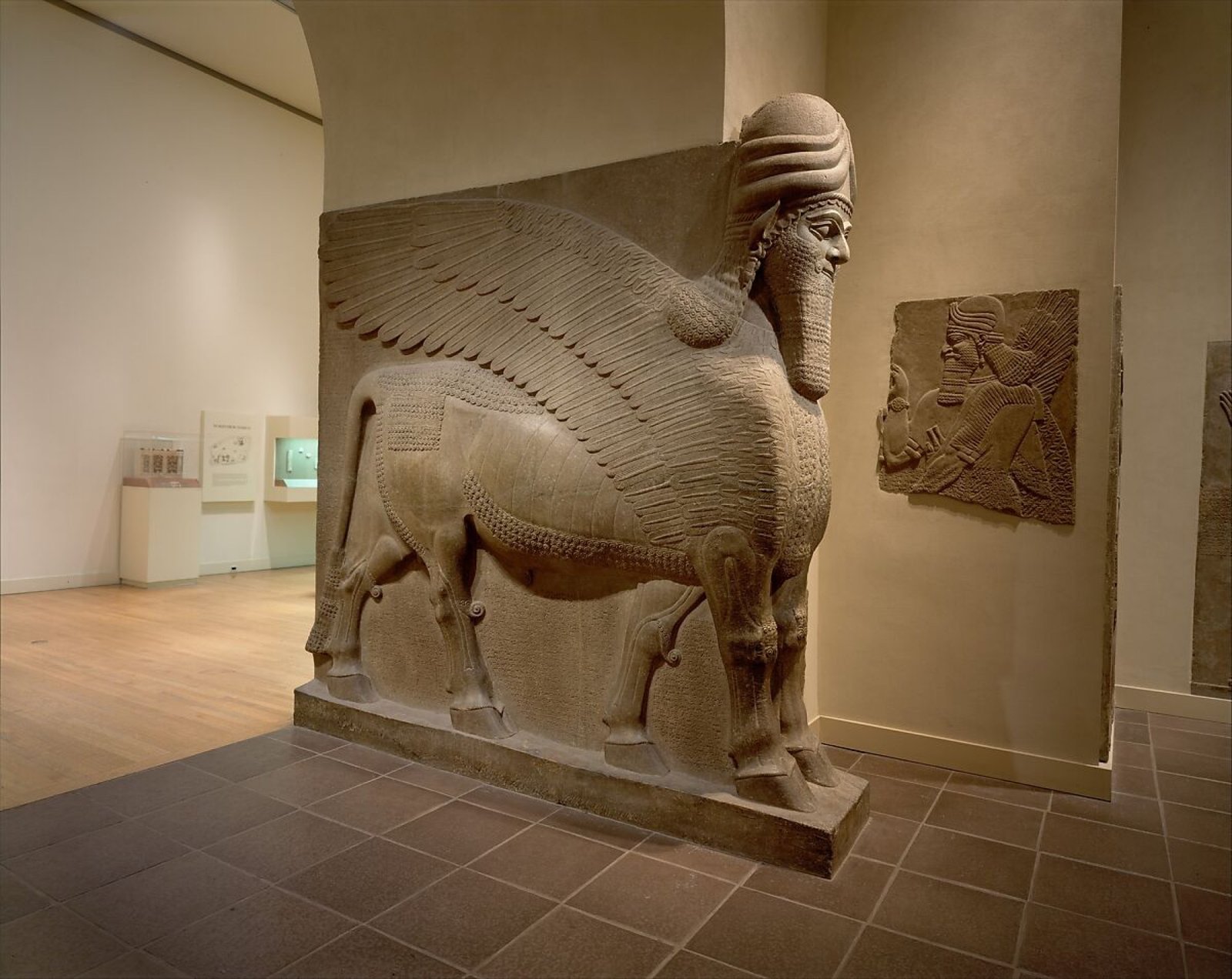
Colossal human-headed winged bulls and lions guarded palace gateways. Modern museum labels often call them lamassu, while ancient terminology was more varied. Their combined bodies expressed intelligence, strength and supernatural protection. Five visible legs allowed the figure to appear stable from the front and striding from the side.[10][11]
Protective beings also appeared in smaller figurines buried beneath floors and in rituals for houses and temples. A lamassu was not simply an “Assyrian god,” national mascot or decorative monster. It functioned within a larger system of thresholds, images, inscriptions and ritual action intended to repel danger and establish ordered space.[10][1]
A changing tradition and an uneven record
Old Assyrian merchants, Middle Assyrian palace communities and Neo-Assyrian imperial scholars did not practise an identical religion. Cities rose and declined, royal patronage shifted and Babylonian learning grew in court collections. Continuity mattered because rituals claimed antiquity; change mattered because every performance occurred in a new political setting.[1][5]
Most surviving texts and monuments come from palaces and temples, making elite male institutions disproportionately visible. Household religion, women’s ritual roles and the practices of deported or rural communities are harder to recover. Clay figurines, graves, domestic archaeology and personal names broaden the picture, but a complete account remains beyond the surviving evidence.[5][2]
Evidence trail
Sources and further reading
- Stefan M. Maul. Assyrian Religion. A Companion to Assyria, Wiley-Blackwell, 2017.
- ORACC project editors. Ancient Mesopotamian Gods and Goddesses. Open Richly Annotated Cuneiform Corpus.
- ORACC project editors. Nanna/Suen/Sîn. Ancient Mesopotamian Gods and Goddesses.
- Simo Parpola and project editors. Knowledge and Power in the Neo-Assyrian Empire. State Archives of Assyria Online.
- Eckart Frahm, ed.. A Companion to Assyria. Wiley-Blackwell, 2017.
Specialist chapters covering Assyrian history, language, cities, institutions and later reception.
- A. Kirk Grayson and project editors. Royal Inscriptions of Assyria online. Open Richly Annotated Cuneiform Corpus, University of Pennsylvania.
Scholarly editions and translations for Assyrian royal inscriptions through 745 BCE.
- Grant Frame, director. Royal Inscriptions of the Neo-Assyrian Period. Open Richly Annotated Cuneiform Corpus, University of Pennsylvania.
Searchable scholarly editions and translations of royal inscriptions; these texts are royal political compositions, not neutral chronicles.
- Jon Taylor and project team. What was Ashurbanipal’s Library?. British Museum research project, 2020–2024.
Research on the size, origins, colophons and archaeological contexts of the Nineveh tablet collections.
- British Museum and LMU Munich. Reading the Library of Ashurbanipal. Open Richly Annotated Cuneiform Corpus, 2022–.
Project documentation and editions for the Nineveh scholarly collections.
- Metropolitan Museum of Art. The Assyrian Sculpture Court. Heilbrunn Timeline of Art History.
- Joan Aruz, Sarah B. Graff and Yelena Rakic, eds.. Assyria to Iberia at the Dawn of the Classical Age. The Metropolitan Museum of Art, 2014.
Museum scholarship on Assyrian art, imperial imagery and interregional exchange.