
Read around all four faces
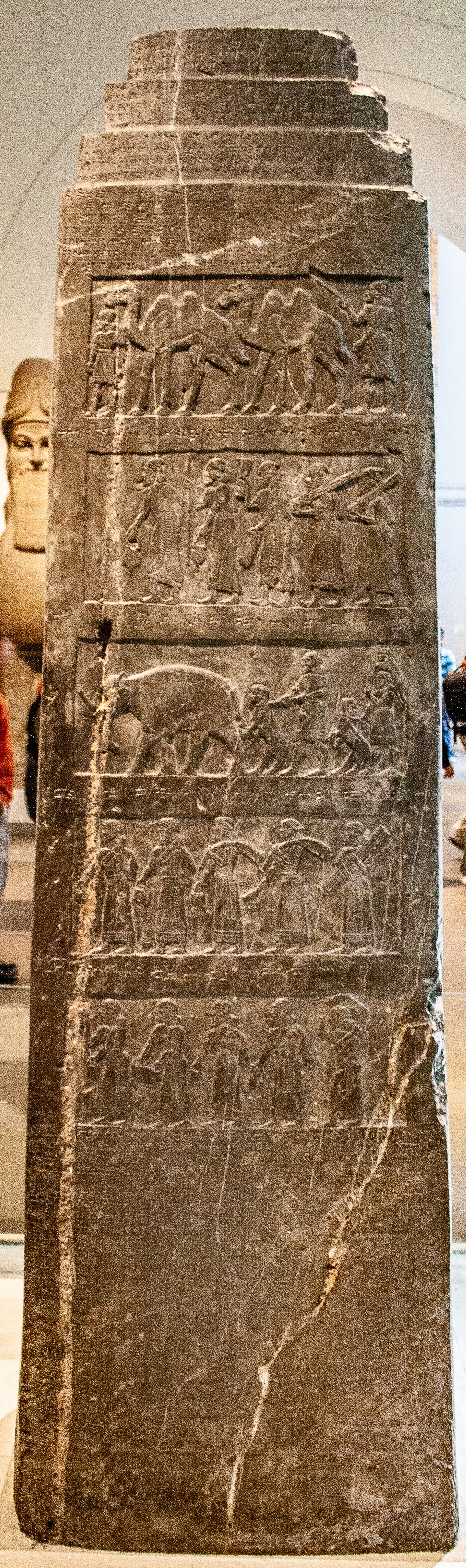
The obelisk combines cuneiform writing with five tiers of tribute scenes extending around its four sides. People, goods and animals appear within an ordered account of Shalmaneser III’s achievements. The monument also commemorates his chief minister, Dayyan-Ashur. Its overall date, about 825 BCE, is not the date of every event represented. The caption associated with Jehu’s tribute, for example, concerns an earlier episode in the reign.[1][2]
Royal success during political difficulty
The ORACC project places the monument in a courtyard of a central building at Kalhu. Its public presentation selected successful campaigning and tribute, while the late reign also experienced civil conflict. That relationship makes the object more than a neutral register of gifts. The inscription and imagery made an argument about authority. The caption naming Jehu should also be distinguished from a modern claim that a carved face provides a securely identifiable personal likeness.[1][2]
An ancient monument and a modern collection object
The object was rediscovered in the nineteenth-century excavations at Nimrud and is now catalogued in London as BM 118885. A photograph of a single face cannot show the whole visual programme. Compare captions, adjacent registers and the other sides before making a historical inference. The reusable photograph linked here shows side C, not every surface or a complete translation. It is credited to its modern photographer, whose licence is separate from ownership of the ancient stone. Keeping these records together allows the image to be used without confusing a modern photograph, an archaeological find and a royal composition.[1][3]
Sources for this object
- ORACC Nimrud Project. The Black Obelisk of Shalmaneser III.
Date, Kalhu setting, four faces, tribute imagery and the monument’s ancient and modern lives.
- British Museum, via Google Arts & Culture. The Black Obelisk of Shalmaneser III.
Museum-supplied object interpretation, registration 1848,1104.1, material and depicted tribute; the museum photo is not reused.
- Szilas, Wikimedia Commons. Black Obelisk of Shalmaneser III — C side.
Exact side-C photograph, named photographer and CC BY-SA 4.0 licence; not an archaeological catalogue authority.