Nineveh Plains · Iraq
Bartella
A town east of Mosul whose church heritage connects Syriac Orthodox and Syriac Catholic histories.
Modern name: Bartella
Also written: Baritle · Barṭella · Barṭəlla
History & community
Bartella lies north of Karamlesh and Bakhdida, between the Tigris and Khazir rivers. Its history belongs to the wider settlement network of the Nineveh Plains.
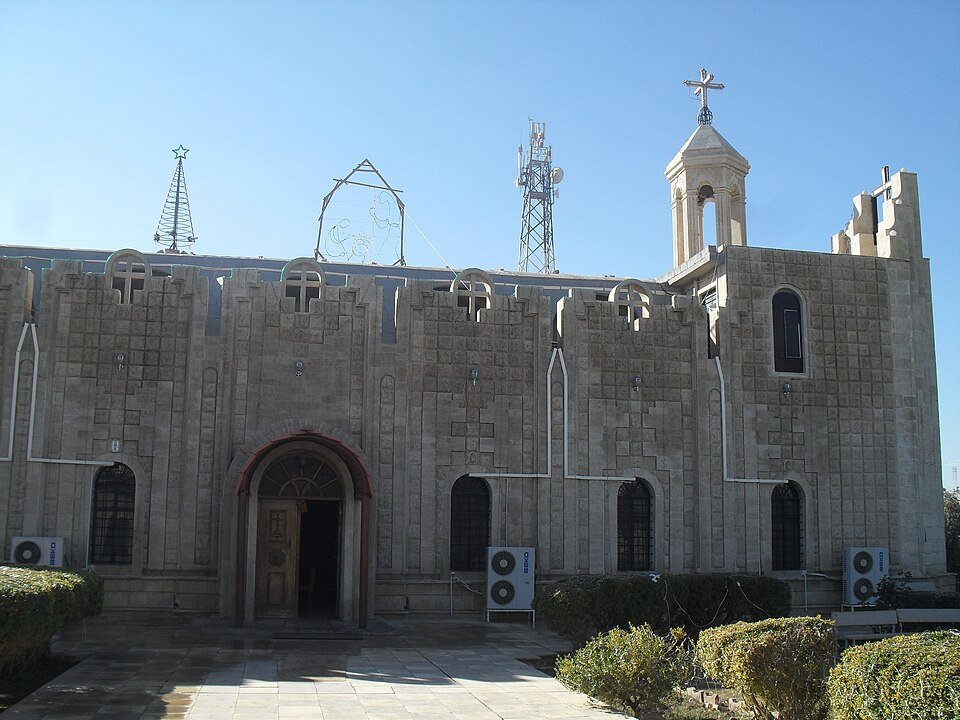
Mart Shmouni is a Syriac Orthodox church dedicated to the mother and seven sons remembered in the Maccabean tradition. Mesopotamia’s field survey documents damage to the church during the ISIS occupation. Mar Gorgis is another important part of the town’s built heritage.
A medieval church centre on the plain
Amir Harrak places Bartella on the route from Mosul toward Erbil and describes Syriac Orthodox and Catholic Sureth-speaking communities. In 1153, Ignatius Loʿozar chose the town as his residence because of its proximity to Mor Matay. Geography here is connected to the movement of church institutions, not just a point on a modern road map.
The account preserves concrete medieval evidence: a baptismal font dated 1342/43 bears the name of Maphrian Grigorios Matay I and was recorded at Mart Shmuni. It also records Bar ʿEbroyo’s foundation of a monastery dedicated to John son of the Carpenters and Susan in 1284.
Church buildings have individual histories
Mar Gorgis includes an older church with an uncertain foundation date and a newer church built in 1934. Mesopotamia Heritage’s June 2017 documentation records burning and damage in the newer building; its December 2017 material records Christmas services and restoration. These observations are dated, not a claim about its condition today.
The present Mart Mariam building was completed in 1890. Its carved marble capitals and basilica plan offer a separate architectural story. Reusing one general conflict description for all three buildings would obscure the evidence particular to each site.
Neighbours and livelihoods
Bartella is not represented here as a single-community enclave. A UNDP report published in August 2018 follows a Christian resident who reopened a barbershop in November 2017 after displacement in Erbil, employing a Shabak Muslim friend. This is an attributed account of two people and a livelihood, not a demographic survey.
Cambridge separately documents the Bariṭle Neo-Aramaic variety. Local language evidence should be read alongside the town’s mixed social setting: a documented dialect does not mean every present resident speaks it or identifies in the same way.
Language
The local variety, also written Baritle or Barəṭle in linguistic work, belongs to the North-Eastern Neo-Aramaic dialects of the Mosul plain.
Related news
No village-specific briefings are in this edition yet. Browse community news →
Sources & further reading
- Mesopotamia Heritage — Mart Shmouni in Bartella ↗
- Mesopotamia Heritage — Mar Gorgis in Bartella ↗
- Uppsala University — linguistic research on Mosul plain dialects ↗
Reference compilation substantively expanded and sources checked: 4 October 2026. No independent specialist review or current population survey is claimed.