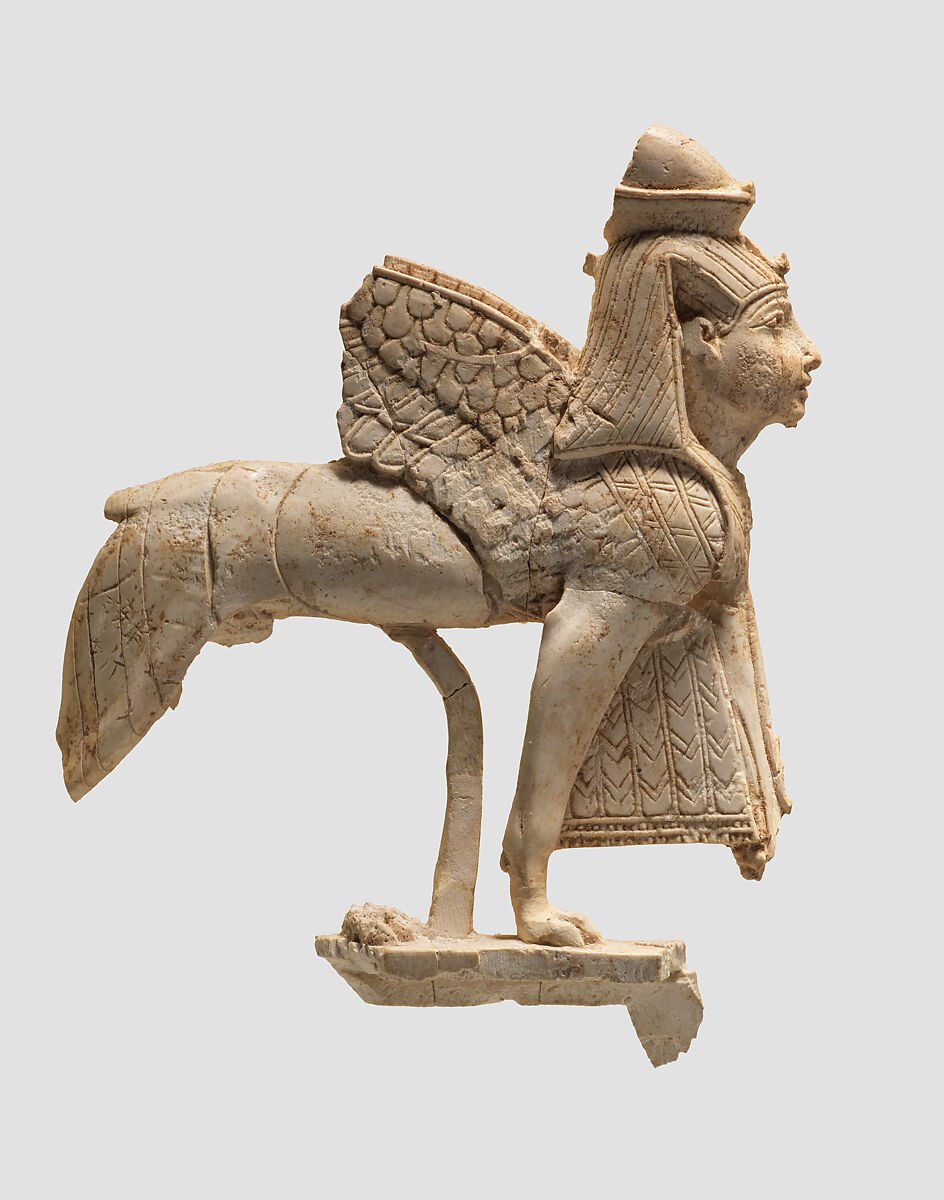
A hybrid creature cut through ivory
The plaque depicts a human-headed winged sphinx striding to the right. Its crown and headdress draw on Egyptian imagery, while the museum classifies the carving as Phoenician in style. Open areas cut through the ivory give the small object a different relationship to light from a solid stone relief. A fragment behind the animal is interpreted as part of a plant form. The original design may have included a corresponding facing figure.[1]
Furniture and the movement of luxury goods
Such plaques decorated wooden furniture, which could also carry paint, metal foil or inlays. The catalogue associates this example, probably, with the Arslan Tash group. That qualification must remain visible. An object’s presence in an Assyrian-period setting does not mean that every part of its imagery was invented by an Assyrian workshop. The plaque invites comparison between the place where a luxury object accumulated, the traditions used to carve it and the more uncertain route by which it travelled.[1]
Small details, different kinds of certainty
Use accession 57.80.1 when following an image into another catalogue. The exact object is more securely identified than every reconstruction of its missing furniture. Distinguish a visible break from a proposed completion, and an Egyptianizing motif from proof of manufacture in Egypt. The museum’s modern classification and the ancient user’s understanding are also different questions. This dossier therefore offers an object to examine, rather than a complete biography of its unnamed carver or owner. For a visual comparison, consider how the nearby oryx plaque uses plants and open space without repeating the sphinx’s human-and-animal combination.[1]
Sources for this object
- The Metropolitan Museum of Art. Openwork furniture plaque with a striding sphinx, 57.80.1.
Object number, ivory material, date, probable Arslan Tash geography, Phoenician-style and Egyptianizing features, and Public Domain image.